BORO BATHOU RELIGION AND BODO SOCIETY_________Haribhusan Brahma.
It was the agitation of the Bodos for Homeland which stirred up the minds of every member of the Bodo community either at home mutely or outside home to participate in the programme of agitation for Homeland appeared to be little confusing in the minds of some thinkers. Remaining in the same land as aboriginal tribes, the demand for seperate Homeland seemed to be very much puzzling to a person like me. Driven in such a confusing state of affair , I came to a conclusion with firm conviction that not exactly land but but what the Bodo people lost was the domination of language and culture over the land. If Bodos are conscious of their language and tradition to take necessary steps to protect and preserve their cultural identity to its utmost glory the present confusion can be avoided in the future.
Bodo people are fundamentally nature worshippers. They are believer in the hidden power of the nature which can strongly dominate the social life. The nature is the cause of peace and sorrow. This simple belief made them pick up 'SIJOU' plant (euphorbia) a cactus of five debries with pairs of short thorns as the symbol of soul with the key power to steer the whole body organs. Thus in the made believe of the god as almighty in Bodo society there is no personality cult . Bestowed with logical and reasoning power Bodo people are most successful to invent the five principles of life called 'BATHOU' in Bodo.

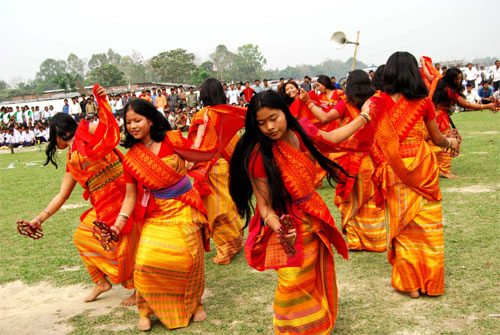
BODO GIRLS DANCING IN TRADITIONAL RHYTHM


A glowing tribute on the studies of language, literature and the general history of Kirat people has very well been paid by the well versed scholar late Mr. Brian Hodgson in this way, "The Kirati on account of their distinctly traceable antiquity as a nation and the peculiar structure of their language are perhaps the most interesting of all the Himalayan races".1Besides that, an intellectual luminary Dr. S. K. Chatterjee in his competent work, "Kirat Janakriti" mentions that Buddha, who is considered as one of the greatest leaders and teachers of mankind, was thought to be of pure or of mixed Kirat origin.
"Many of us are not as yet alive to the nature and importance of the problem. Closer study through the various human sciences should be carried on with greater intensity through linguistics, through sociology, through anthropology, through political history and through comparative religion". 2 Although these scholars during their times could not get enough opportunities to utilize a good number of primary sources in the form of MSS and colophons on the subjects of Kirat studies, the present author is thankful for their painstaking efforts that have been taken on the present subject. However, now there is a vast storage of Kirat MSS in Kirat scripts. Among them are the MSS in the, “Srijunga or Limbu", scripts and the, "Rong or Lepcha" scripts and the treatment of the present subject is based on these sources.
In fact, the term Kirat is a corrupt form of Kiriat, Kiryat or Kirjath which means a fort or town in Moabite language of the Mediterranean region.3 When their number increased, they built many forts and towns and called them Kiriat-hime, Kiryat-yarim, Kirjath-arba, Kiryat-baal, Kiryat-hujro, Kiryat-sanna and Kiryat-sapher which indicate the meaning of the town or fort of the forest, or the town of the god Baal, or the town of books, or the town of palm trees. The residents of the above noted towns started calling themselves, “Kereti” which later on became Keretite or the Kerite tribe. The ancestors of this tribe if identified, comes to Nahor; the younger brother of Abraham, a resident of Ur in Babylon. He belonged to the Semitic family. When the Hebrew people under the leadership of Moses, invaded their country, they were defeated and expelled from their native land. The Kereti people then led a nomadic life and spread towards the eastern and north-eastern countries.4 In 2400 BC, a branch of which came to Mesopotamia5 or the Assyrian country, intermingled with the Ashur people and formed one nation with them. Later on they migrated to Northern India and the Himalayan region via Media and Nisa of Northern Persia with the title of the Kirat-Ashur tribe. But in Nisa they were called Khambos or Yavan and claimed their descent from the Greeks of the Ionian island.6 In the Sanskrit book of Yogini Tantra, the Kirat nationality is included among the Yavan, Pallava, Koch and Pulinda races. The Greeks had also known the Kirats by the name of Kirhadai. The last remnant of the ancient Kiratite or Cherethite tribe was found recorded in the book of 2 Samuel, 15 - 18. They were a martial tribe during the reign of the Syrian King David in 1049 BC.7
There is no doubt that the Kirat-Ashur people came to North India earlier than the Aryans yet they had known them very well in Persia.8 As the Assyrian country was mountainous and the Kirat-Ashur people were great hunters,9 they preferred to live in the mountainous countries of Kabul, Kashmir, Karakoram and all the Himalayan regions, though some of them migrated to the Indian plains and lived there for about twelve generations.10 "There were certain principalities which were definitely styled as Nishada in the epic and Alavaka in the Pali Texts and were doubtless of non-Aryan origin."
Buddhist writers refer to other Yakkha Principalities besides Alavaka."11 The Kirat Vansavali mentions that after twelve generations, one branch of Kirat people migrated from the Indo-Gangetic plains to the Himalayan region and the other branch to Lanka or Ceylon to the south.
It is for this reason that some scholars admire to find one of the aboriginal tribes of Ceylon with the name of, “Yakho” similar to the Yakkha-tribe of Eastern Kirat people of Nepal.
The origin of the Kirat people of Nepal can be traced back in combination of three races. According to the Kirat Mundhum or tradition, three races are known by the names of Khambongbas or the Khambos, the Tangsangthas or the Mongols and the Munaphens or the Chinese. The Khambongbas or the Khambos were the first immigrants to this Himalayan region. The Tangsangthas or the Mongols and the Munaphens or the Chinese people came in later periods and intermingled with the Khambos and constituted a big human race. They spread from this Himalayan region to India, Burma, Syam, Vietnam, Malaya and Philippine islands,12established their kingdoms and kept their respective records of history. In India, Kirat people occupied the regions from Himachal Pradesh to Assam in the north and from Manipur to Chittangong in south-east.
Sir John Hammerton in his book called “Early Races of Mankind", mentions that probably in the 4000 BC, there was a civilized race of mankind on the lower Euphrates of the Mediterranean region described as Mongolian or Summerian of the Cheldean. They had their own independent forts or towns. They used to fight for their border line and had erected an inscribed stone pillar of agreement in the middle of their boundaries. The defeated town never agreed to live under their enemies. They used to quit their native place for good and migrate to other countries. In like manner, in about 3000 BC, a big horde of people left their native place and came to the east and established the Chinese Empire.
In the Kirat folk-lore of Kabul or Golku, it is said that the Hazara tribe of Kabul and the Kirat tribe of Nepal were of the same group in the beginning when they first came from Persia. Later on, the news of the prosperous country of the Indian plains tempted the Leader of the group, the elder brother of the Hazara tribe, Laley Hang. They came to the India plains just for a visit and returned back. But they instead of going back to Kabul, went ahead into Nepal and came to be known as Gorkhas. The Hazara people say that so long as they were in one family, they were neither Muhammaden nor Hindu; but when the brothers separated, they became weak and the Pathans invaded their country, defeated them and converted them into Muhammadanism. The Kirat Gurkhas of Nepal, however, became Hindus. Even till this day, whenever a Hazara meets a Gorkha, he calls him Chacha, which means uncle.
When the Aryans came to India for the first time and started to advance towards the hilly regions, they had to fight against a Kirat-Ashur king whose kingdom was situated on the bank of river Indus in the Himalayas. His name was Shamba15 Ashur. He was defeated in the battle, so he left his place and came towards the east and established a stronghold in the Kinner land16 which is now known by the name of Himachal Pradesh in India. In this place, a horde of Mongolian people came and intermingled with this stock of Kirat people and constituted one big Kirat race.17 Gradually they spread towards the east and settled in Nepal. Courtesy: History and Culture of Kirat People. 2003. Kirat Yakthung Chumlung
BATHOUISM A RELIGION PRACTISED BY THE BODO TRIBE OF BODOLAND AREA OF ASSAM IN INDIA IS DESCRIBED BY HARIBHUSAN BRAHMA , RETD. PRINCIPAL OF GOSSAIGAON COLLEGE THROUGH WOOD CURVINGS.
In a bid to trace classical elements in Kherai dance of the Bodos, the Srimanta Sankardev Kalakshetra is conducting a study on the Bathou festival and the recital.
The study is being conducted by the documentation wing of the Kalakshetra, through seminars, workshops and spot documentation. There is hope to elevate the Kherai dance to a classical form in the long run.
Though Kalakshetra has been organising folk festivals of various tribes and communities of the region, this is the first time that the Bathou festival is being celebrated at the centre. A seminar was also organised on the occasion where experts deliberated on the relevance of the festival.
The Bathou festival is a religious performance, which includes 18 varieties of dance forms.The Kherai dance, performed as part of the Bathou festival, literally means paying oblation to God. The festival is organised for the wellbeing of the community.
Classical traditions are derived from folk elements. The Kherai dance also has many characteristics, which are essential ingredients of a classical dance, like a definite base and framework, a long history of traditional culture and a fixed musical and dance form.
The Bodos, also called the Boros, are an ethnic community that is concentrated mostly in the north-western parts of Assam in India. They are said to belong to a larger classification of ethnicity called the Bodo-Kachari. The nerve center of the Bodos is the city of Kokrajhar. Image File history File links Download high resolution version (450x662, 92 KB) Summary A Bodo girl in the traditional Dokhna ©Gautam Chandra Baro Licensing File history Legend: (cur) = this is the current file, (del) = delete this old version, (rev) = revert to this old version. ...
Kachari is a generic term applied to a number of groups speaking a more or less common dialect or claiming a common mythical ancestry. They are regarded as aborigines or the earliest known settlers of the Bharmaputra Valley- which includes the whole of Assam, North Bengal and parts of Bangladesh. They are thought to have originated from Siberia, although remnants of their original stock have not been identified as yet.
Based on an 1881 census, there were 18 groups within the Kachari definition, which included the Bodo, Dimasa, Lalumg, madani, Mech, Rabha, Saraniya, Garo (tribe), Rajbangshi (Koch), Chutiya, Moran, Hajong, Tippera (Tripuri), Mahalia, Dhimal, Solaimiya and Phulgaria. The Garos are a tribe in Meghalaya, India who call themselves Achik. ... The Tripuri people are the original inhabitants of the state of Tripura in North East India. ...
Some of the groups, such as Chutiya, Moran, Saraniya and Koch do not consider themselves as Kachari as they have been Hinduised. Other groups, such as the Garo, Rabha, Lalung and Hajong, having been isolated from the parental stock, have established separate identities. With the exception of the Garo, which is still matrilineal society, these groups once followed the rule of matriliny.
The Mech in Western Assam, the Bodo in central Assam, the Dimasa and Hojai to the north of Chachar Hills, and the Sonowal and Thengal in the eastern part of the Brahmaputra now represent the Kachari. The Brahmaputra is one of the major rivers of Asia. ...
The Bodos are the largest tribe of the Brahmaputra valley. They divided into a number of clans such as the Basumatary, Sargwary, Mushahary, Ishlary, Boro, Sibigri, Narzary, Dwimary, Goyari and Brahma. Though the numbers are in dispute, the census report from 1971 state the Bodos as being the 8th largest tribal group in India, with Bodo being spoken by about 0.8 million people.
The Bodo language is part of the Tibeto-Burmese family of languages. The tribe recently adopted the Devanagari script formally, although the Roman script has also been extensively used- particularly due to the influence of Christian missionaries in that region. According to some scholars, the Bodo language had a script of its own called Deodhai. Bodo is a Tibeto-Burman language spoken by the Bodo people of north-eastern India and Nepal. ... The Tibeto-Burman linguistic subfamily of the proposed Sino-Tibetan language family is spoken in various central and south Asian countries:
The Bodos are thought to have introduced rice cultivation and silkworm rearing to the region. The traditional favourite drink of the Bodos is Zu Mai- Zu meaning beer, and Mai meaning rice. Rice is a staple of the Bodos and is often accompanied by a non vegetarian dish such as fish or pork. Bodos are traditionally non-vegetarians.
Weaving is another integral part of Bodo culture. Many families rear their own silkworms, the cocoons of which are then spun into silk. Bodo girls are taught to weave from a young age, and no Bodo courtyard is complete without a loom. Most women weave their own Dokhnas (the traditional outfit of the Bodo women) and shawls. The Bodos are also expert craftsmen in bamboo products.
The Bodos practice a number of religions, with Bathou being the primary faith, along with Hinduism and Christianity. Image File history File links Kerai. ... Image File history File links Kerai. ... Image File history File links Drums2. ... Image File history File links Drums2. ...
Bathouism is not strictly animism, though it has been thought as such by outsiders. It is based on the belief of an infinite and eternal god called Obonglaoree. Legend has it that the infinite god became tired of his formless existence and shaped himself as a human being called Jiw Borai, or Old Soul.
Efforts have been made to identify Jiw Borai with the Hindu God Shiva. Several elements of Hinduism have been incorporated in the Bathou religion over time.
In the Bodo Language Ba means five and thou means deep. Five is a significant number in the Bathou religion.
There is no fixed place of worship for the Bodos. The altar is placed in any convenient location around the household, usually in the courtyard. For the Kherai Puja- the most important festival of the Bodos, the altar is placed in the paddy field. Other important festivals of the Bodos include Garja, Hapsa Hatarnai, Awnkham Gwrlwi Janai, Bwisagu and Domashi.
Despite the advance of Hinduism amongst the Bodos, Hindu practices such as caste and dowry are not practiced by the majority of Bodo Hindus.
Special customs of the Bodo death rites
The Bodos belong to the great Mongoloid stock of man. According to history,
the Bodos were permanent inhabitants of Mongolia but in the course of time,
their forefathers left their original abode group by group for other parts of the
world in search of more fertile land and they finally settled permanently all
over the northeastern region of India primarily in Assam, Arunachal Pradesh,
Nagaland, Manipur, Meghalaya, Tripura and the northern parts of Bihar and
West Bengal.
However, the Bodos were concentrated in the districts of BTC (Bodoland
Territorial Council) namely Kokrajhar, Chirang, Baska and Udalguri. They are
also found in other districts like Goalpara, Lakhimpur, Sonitpur, Dhemaji,
Nowgaon, Morigaon, Karbi – Anglong and even in India’s neighbouring
countries like Bhutan and Nepal.
“The Bodos, earlier known as ‘Kachari’ are a Hinduised Tribe of Tibeto –
Mongoloid origin. Their language was identified as one of the major languages
of the Tibeto – Burman family. The other neighbouring communities which
belong to the same linguistic family are Dimasas, Kachari, Rabha, Tiwa,
Tippera, Sonowal Kachari, Missings, etc. This is one of the oldest and most
dominant communities of the Assam plains. This community stayed peaceful
with neighbouring Assamese and non – Assamese communities and shared
many cultural traits and behaviour”
Bidding the final farewell
The word ‘Bodo’ was first used by the European scholar, Hudgson to refer to a
group of languages of the Mongoloid race and Tibeto – Burman group of
people inhabitating the hills and plains of the entire northeastern region of
India.
The system of cremation of a deceased person of the Bodo society is
noteworthy. Generally, the body of the deceased is taken out from the house
and kept in the middle of the courtyard. Before laying out the dead body, the
south corner of the courtyard is cleaned with water. If the deceased is a male,
the body is then dressed in a new gamcha and if the deceased is a female, a
new Dokhana is used. The body of the deceased person is then placed in such
a way that the head is towards the south. If the deceased is a married male,
then his wife will show her last respects by kneeling down and removing her
‘sindur’ (vermilion) with the help of the toe of the right leg of the deceased
person. Then other members of the family as well as the relatives will offer
food, one after the other to the deceased.
If the deceased is a married woman, two spots of sindur are then put on the
forehead of the deceased and if she is unmarried only one sindur is used. “The
dead body is placed on a Sangra which is a kind of trellis made of raw
bamboo. The projecting bamboo poles which rest on the shoulders of the
pallbearers are called ‘Bathi’. The pallbearers are called ‘Gwthoi Bangra’.
Generally the corpse is carried away by the sons or the relatives to the
cremation ground. In the villages, at least one male member from each family
is expected to make an appearance at the house where the death has occured.
The procession is led by the Deori (priest). According to the belief, a deceased
individual needs a few things for the journey after death. Those who
accompany the deceased person to the cremation ground show their last
respects by sprinkling a few drops of water on the dead body with the help of
the leaves of the fig tree (Phakhri Bilai).
There are two types by which the dead body is disposed of in Body society.
These are:
Burial System - In the early days, the Bodos generally preferred the burial
system of disposing a dead body. Even today, this system is practised in many
places. In this system, the body is covered with a white cloth and slowly
lowered into the grave with the head towards the south. A few coins and
cowrie shells are also buried along with the body. It is said that thee soul of
the deceased person may be required to cross a river by boat and these coins
can be used to pay the fare to the boatman and also the soul may need to
purchase some food on his journey.
A small hole is left in the earth which allows air to reach the nose of the buried
person. It is believed that by doing so, the spirit of the dead entering the body
is helped to breathe. A pitcher full of fresh water is placed on the grave as a
drink for the dead. A little rice is also coked out on the spot of burial and is
left for the deceased. It is believed that the soul of the dead may start its
journey after partaking of this rice.
All the people who accompany the dead body to the cremation ground are
supposed to take a bath in the river or pond before going back home and they
touch or chew the Narzy – gwran. By doing so, the mourners signify that they
have separated their relationship with the dead person from that day forth.
Thereafter, a piece of red thread is placed on the lips of the dead body. It is
believed that on placing this piece of thread on the lips, the deceased will have
red lips upon being reborn. The Bodos believe that as a result of using leaves
of the Indian fig tree, the lips of the deceased become small and thin upon
rebirth. A branch, full of leaves of this same tree is planted at the head of the
grave of the burial ground. This practice has a deep significance. According to
their belief, by doing so, the dead person will have beautiful hair upon being
reborn. If the person is a male, his soul will rest under the fig tree until it
attains salvation.
Cremation System – When the corpse of the deceased is to be disposed off by
burning, a funeral pyre is
arranged. There is a system of placing five or seven stacks of wood while this
funeral pyre is arranged. The relatives and friends of the deceased pass around
the funeral pyre in a procession, the men five times around and the women
seven.
All the people who accompany the dead body to the cremation ground are
supposed to take a bath in the river or pond before going back home and they
touch or chew the Narzy – gwran (dry leaves of the jute plant). The Bodos
believe that by doing so, the relation between the deceased and the funeral
party is severed from that day forth. After returning from the rivers or ponds,
the Deori (priest) sprinkles holy water on them for purification. Thereafter the
members of the funeral party enter their respective houses after bowing down
before the altar of the Bathou. The Brahma Dharma believers enter their
respective houses only after purifying themselves with the holy water kept
ready in front of their houses. Finally, they gather together at the house of
the deceased after changing their attire at home. The funeral party is then
entertained with Jumai (rice beer). Nowadays, tea is offered in place of Jumai at
such occasions. At the house of the deceased, the people
discuss the ‘shradha’ of the deceased person.The shradha is generally held
either on the eleventh or thirteenth day after the date of death. The villagers
once again gather on the night prior to the shradha. This is known as ‘Daha’
or ‘Daha sarnat’ (Saradu) which means to give up grief. The Bodos of Darang
district now called Udalguri district call this the ‘Gyati Jawnai’.
The ceremony is performed simply by offering some of the favourite food to
the deceased person. This is called ‘Gwthoinw Baonai’ (offering food to the
deceased person). In this regard, the Deori plays an important
role from the start to finish. The whole ceremony is conducted by him. On
Saradu day, there is a traditional custom to feed the villagers and the relatives.
On the next day viz. on the Shradha day, the ceremony is performed by
praying before the altar of Burai –
Bathou in the traditional fashion. According to Bathou believers, the following
functions are performed during the Saradu:
a. Phindu Garnai
b. Phaphli hwkhlai nai
c. Ishing baonai
Pindu Garnai – The Phindu Garnai is one of the most important functions to be
performed by the Bodos during Saradu day. For this, all essential materials are
made readily available prior to the Saradu. The head of the family of the
deceased person who keeps Saradu should prepare the food for the deceased
person and keep this ready. All these food items prepared should be kept
inside a large ‘Kho’ (bamboo made) covered by a white cloth for the next
morning. At dawn, all these food items are taken to the river or the cremation
site for disposal. On reaching the destination, an altar is prepared for
worshipping or offering the food items to the deceased person. In the
eventuality that the deceased is a female, seven leaflets of the banana tree are
placed on the altar and five if the deceased is a male. Four bamboo branches
are planted on all four corners and all the four corners of the white piece of
cloth should be tied up. One bamboo branch should be planted to the
southern side of the altar where a piece of white cloth is tied up like a flag. A
pitcher full of water is kept in the middle of the altar.
Phaphli hwkhlai nai – This customary function is observed during the Saradu
day to show respect or honour to the people who carried the deceased person
on their shoulders to the cremation ground. They are seated in one row on the
Khamphlai (a low wooden stool without legs). The head of the family of the
deceased person honours them with a pair of betel nuts, a pair of betel leaves
and some coins. This is offered as the head of the family kneels down in front
of them and begs for their pardon for any kinds of mistakes made by him
beyond his knowledge. Their shoulders are then massaged with pure oil for
seven times if the deceased is a female and five if the deceased is a male.
Ishing baonai – This customary function is also to be performed during the
Saradu. A Khamphlai without legs is placed on an upper portion of banana
leaves at the southern corner of the courtyard after it is washed. The
Khamphlai is covered with a piece of white cloth and then a pair of betel nuts
and a pair of betel leaves and also all the clothes used by the deceased person
are placed on the cloth. Then all the members of the family of the deceased
person show their respect by kneeling down for the last time. At that time, the
Gwthari (priest) sprinkles holy water on them with a chant of Bathou manthwr.
On the Saradu day, the family of the deceased arranges for entertainment for
their relatives, friends and the villagers with various food items. In early days,
the villagers and the relatives of the deceased were entertained with jumai (rice
beer) which was produced in abundance. Nowadays such type of entertainment
has been abandoned by the All Bathou Religious Union. At present, only tea is
offered at the Saradu ceremony. Similarly, serving of meat or fish like oma –
bedor (pork), dao – bedor (chicken), etc. were also common in the Saradu
ceremony. Nowadays, this kind of practice is also banned.
The most interesting and attractive aspect of the ceremony is the arranging of
‘Dan Sarnai’ performance. At the end of the entertainment, a custom of giving
alms in the form of coins is followed. Generally, such coins are mixed with
uncooked rice and are thrown in the air amidst a large gathering of children.
This is known as Dan Sarnai where in the Bodo language Dan means alms and
Sarnai means to give away. The responsibility of conducting the whole
function rests on the eldest son of the deceased person if the deceaseded is a
male. Otherwise, the whole function is arranged by the head of the family.
Nowadays, of course, it is compulsory to offer some fixed quantity of rice, dal
etc by each family of the village which strengthens unity and integrity
among the villagers.
The followers of the Brahma Dharma perform Ahuti during the Shradha
ceremony. As soon as the Ahuti is over, all people assembled at the function
are entertained with a common meal. Serving of jumai during such a ceremony
is totally restricted. However, jumai is sometimes served just after the main
function including the Suwa garnai (removing of impurities) is over.
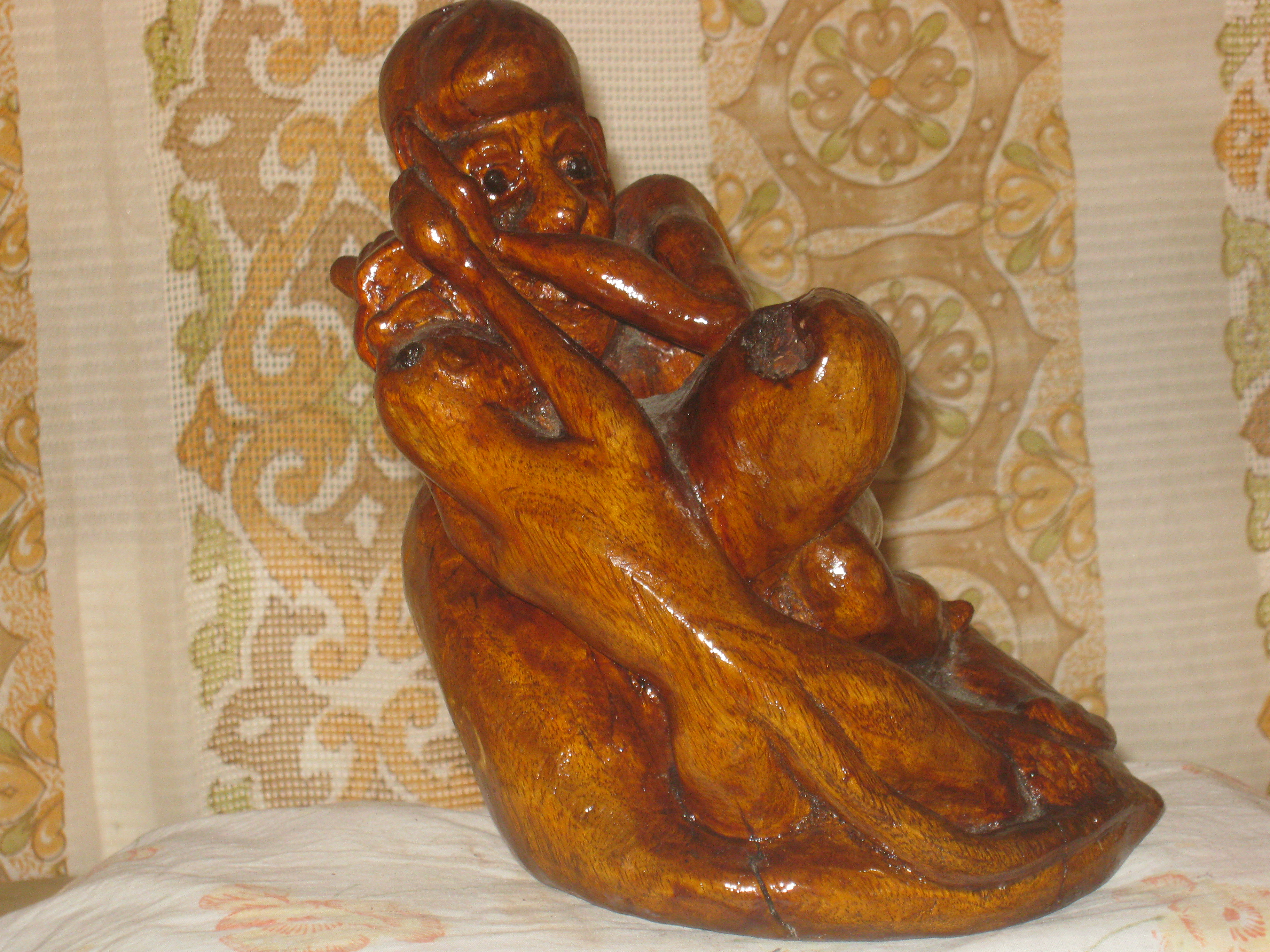
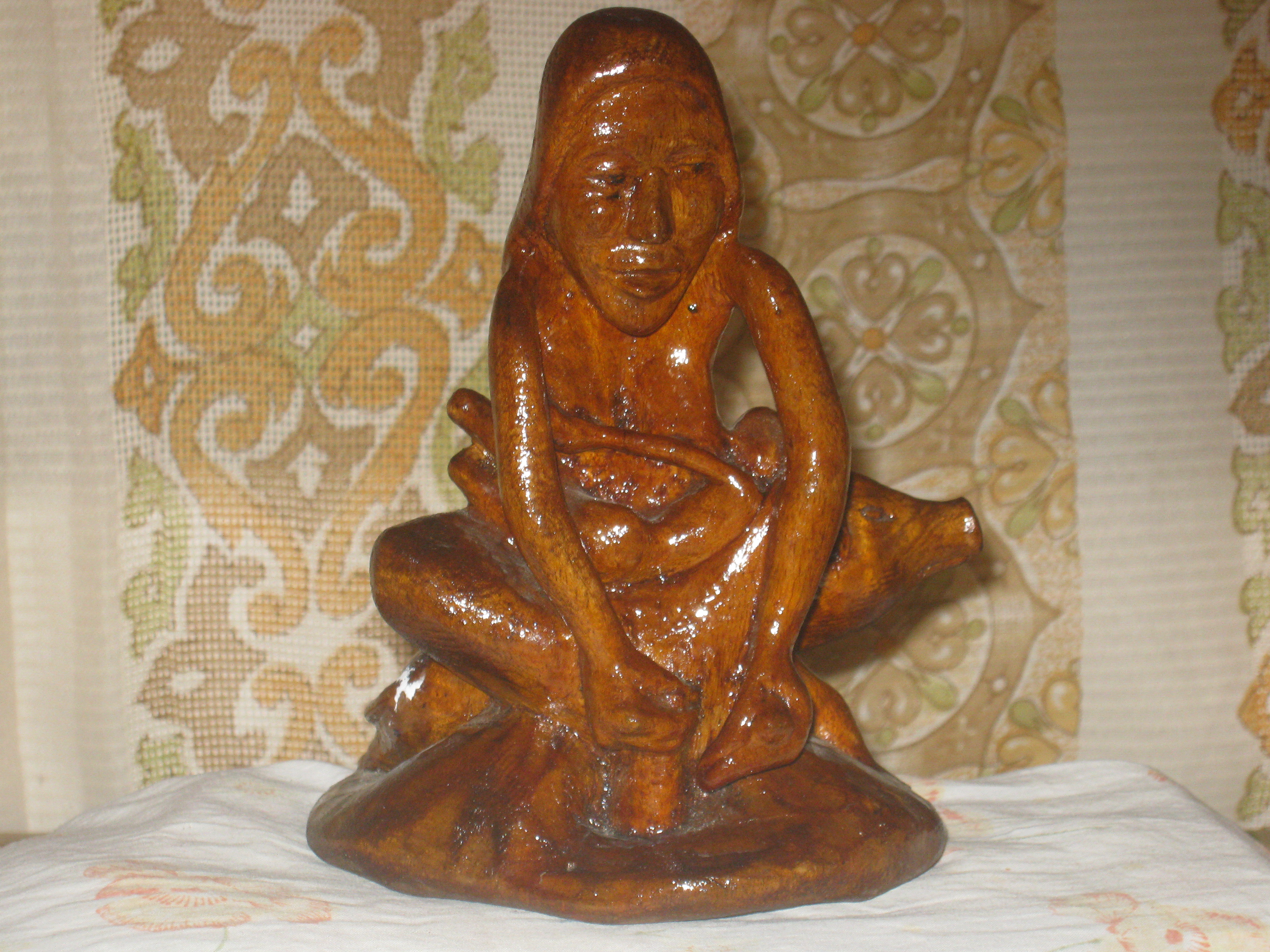
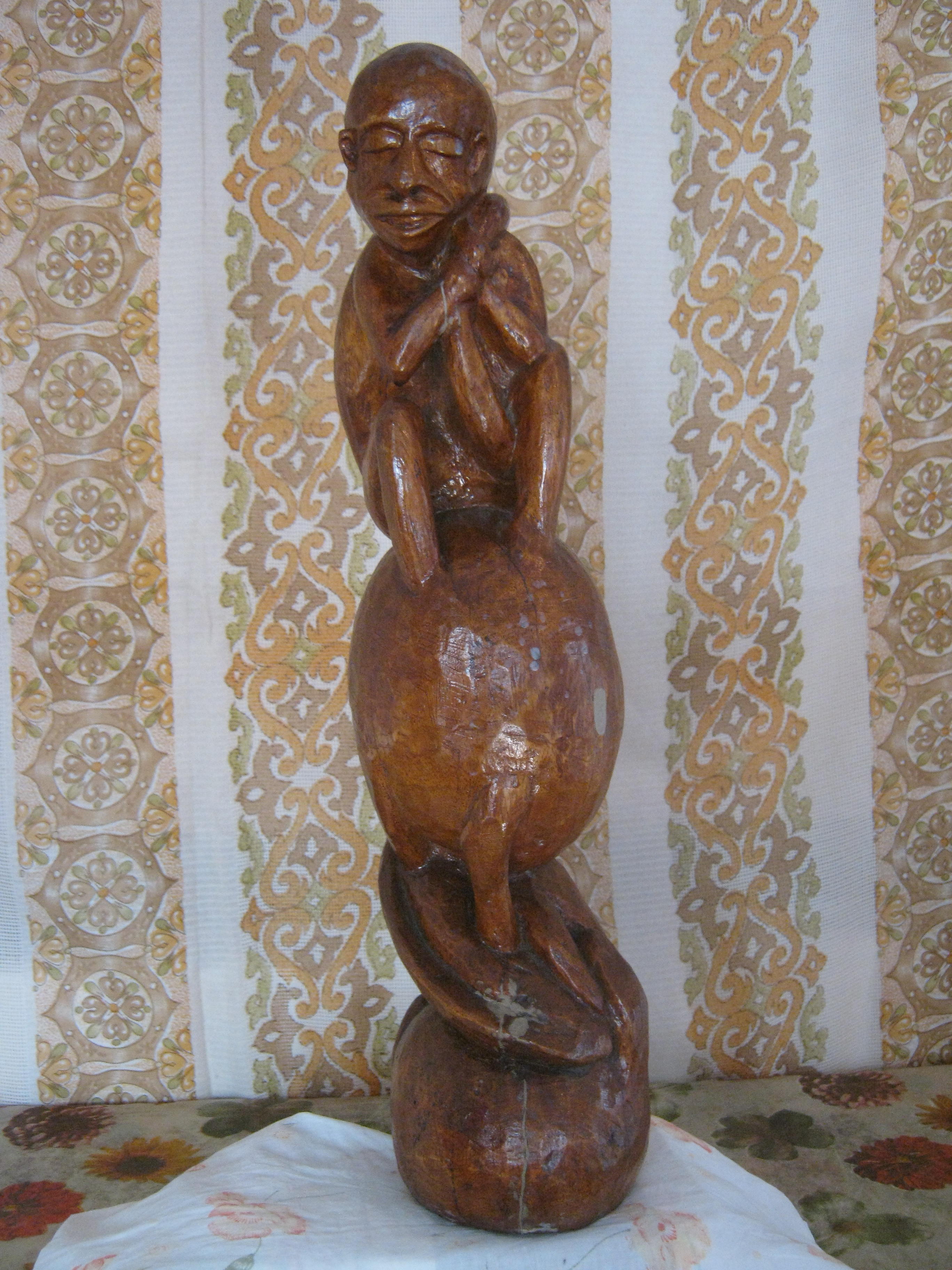
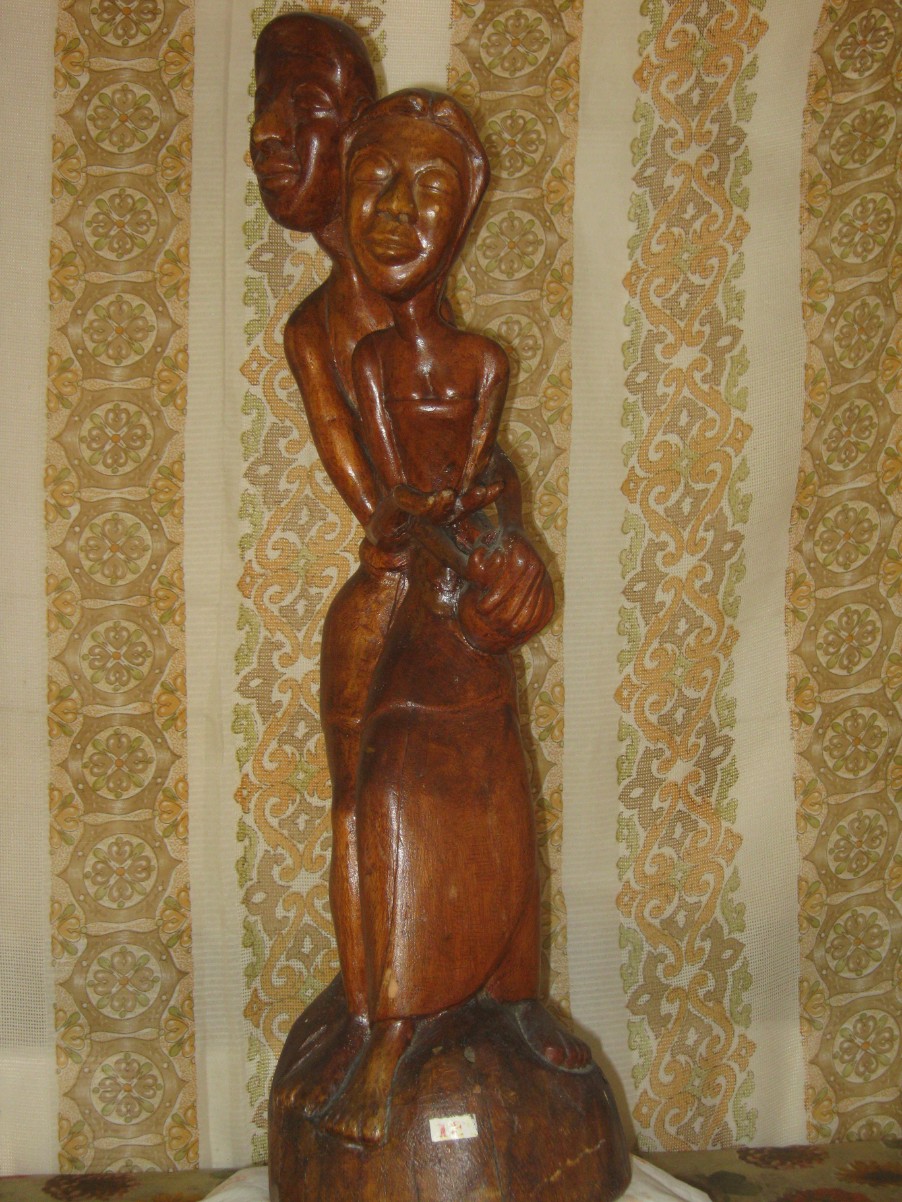
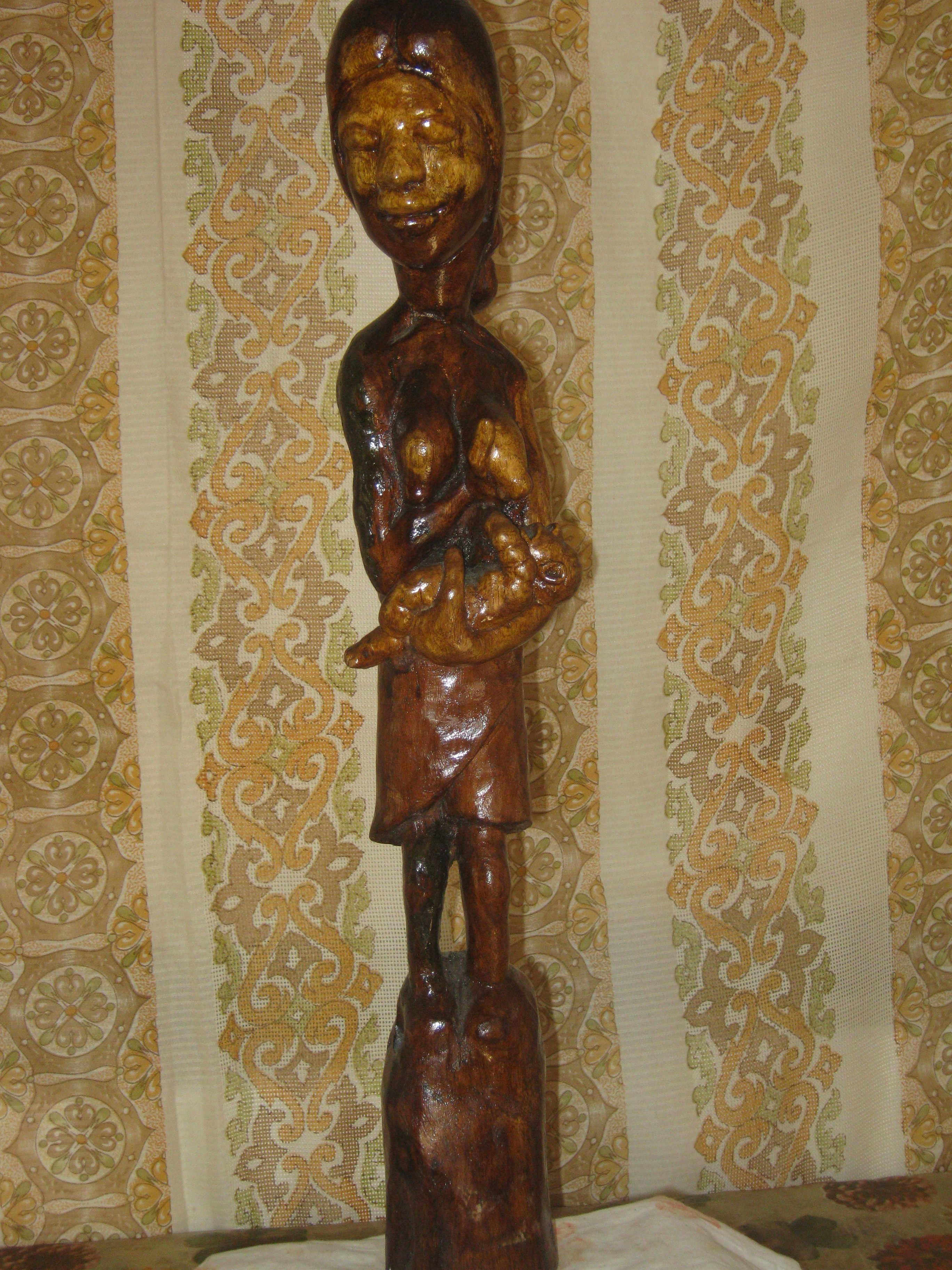
BOROBATHOU ON WOOD CURVING
---------------------------------------------by Haribhusan brahma.
My basic idea is to speak out the traditional culture of the bodo communities. As a
matter of facts the Bodo people has its own culture to identify themselves as a distinct
community from other communities as regard to their livelihood, religious concept, and
performance thereon relevant musical instruments, kham, siphung, jothas in the performance of
religious festival kherai. They till their lands and cultivate various crops paddy, jute etc.
etc.Womenfolk rear eri work and spin the cocoons, they also weave their own costumes.Thus
i have worked on tradition bound materials like man with plough on the shoulder moving
towards the field of work, woman spinning eri cocoon with
baby on her lap.Women also tame domestic livestock like pig, hen etc.
I have also worked on religious concept Bathouism depicting structure of Bathou
altar and personification of Sijou, a cactus known as Euphorbia. My work is also based on
folk tale like Chandw Baodia and also on bodo legenderyhero like Basiram Jwhwlao, Alari
Dambra, womenfolk carrying food to the manfolk.
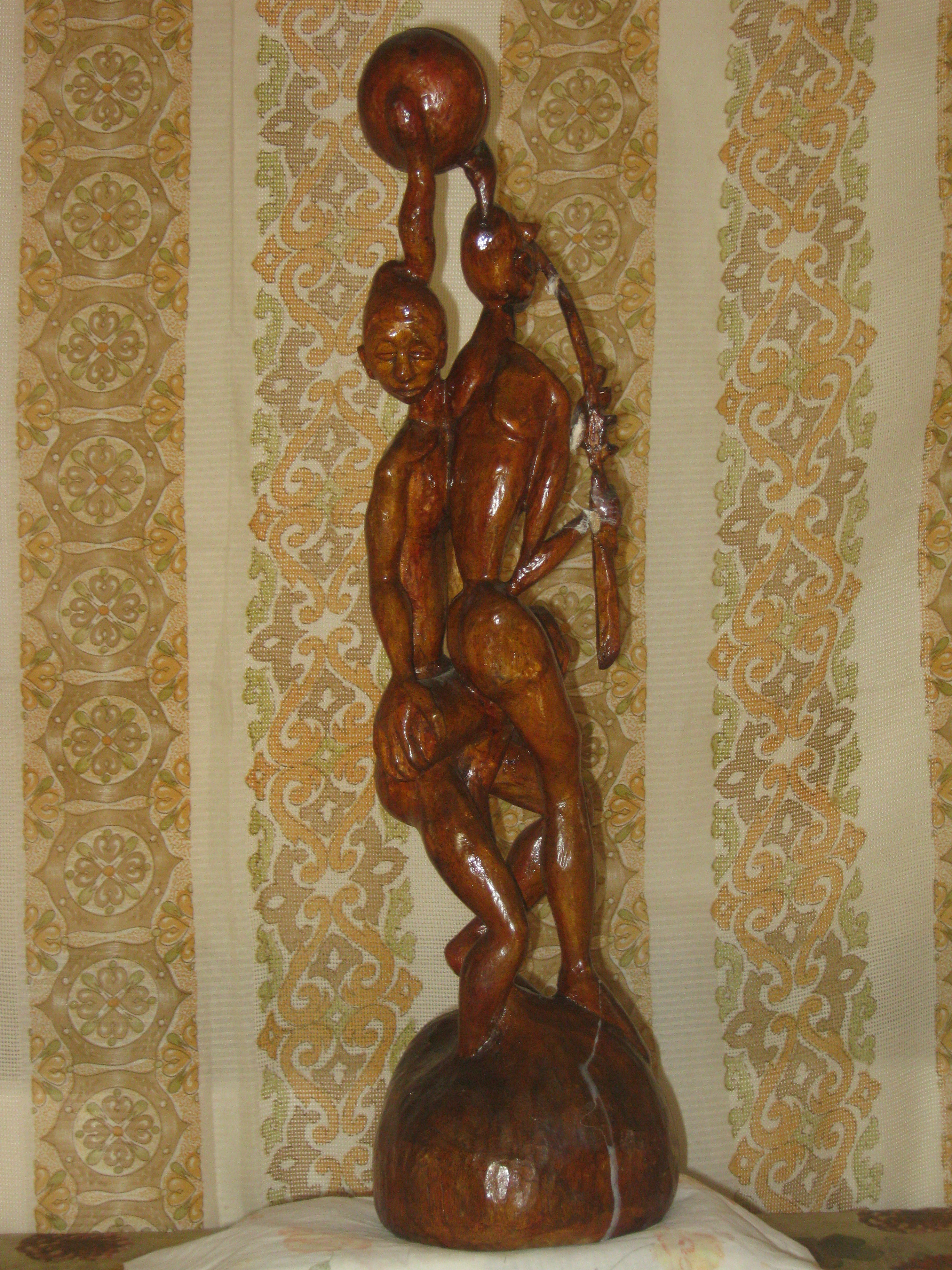
(48) Hide out
In the north east india at the time of ethnic upsurge the extremists prefered dense forests as their hide outs. In the carving an extremist is seen entering into his hide-out.
(49) Groaning woman
All ill behaviour meted upon the female sects has made their lives miserable They need liberty from all these misbehaviours. In the piece of wood carving a woman is shown as groaning to get rid of these ill-treatment of the males.
(50) Human civilisation at the peak
Covering body is the first indication of civilisation of mankind because nakedness is considered uncivilised. But when the so called civilisation reaches its highest order , human behaviour comes down again to the level of uncivilised is depicted in the carving.
(51) loan and its impact on weaks
Any kind of loan seems to be for the benefit of the indebtors if the loan is properly utilised for the profitable investment. In he society those who are economically weak they take loan and most of them are found to spend in consumption rather than in profitable investment. This way indebtor is always overburdened with capital and interest. Such irresponsible loanee is always victim of adverse impact of loan.
In the wooden carving monkey is shown to be in better position and the turtle is shown in the worst position in the globe. Monkey is shown extending monetary help to the turtle to rise economically to the higher position. Turtle naturally cannot climb up the tree . The monkey twisted his tail in the neck of turtle to help climb up the tree. The turtle is tempted by the loan offered by the monkey and was in a trapped in loan.
(52) boat of life
It is presumed that the happiness of life is conditional.Our mind always hankers after
having much for making life happy. But too much of having properties make life
imbalance.Mostly wealth acquired more than necessary is utilised in matters which are the
causes of miseries.Therefore the happiness of life depends on having as much as as the
desire for the satisfaction.There must be a balance between having properties and desire.If
we cross the limit misery is bound to come. In the curving attempt is made to depict the idea.
The woman is seen to caution the man with a bottle of wine to drink upto the limit of
giving pleasure and keeping health in sound.or to face the adverse consequences.
Bathouism _____ A concept
Religion emanates from the believe in the existence of god. Even the big space scientist
like Dr. A. Kalam, the present Hon'ble president of India is not away from the believe in the
existence of some supernatural power who has created this mysteriousuniverse. But none is sure
about his whereabout existence and what does he look like. In such a doldrum mankind had to
imagine and draw a concepton the figures of creator or god.
This concept leads to formulation of certain sets of rules by different groups of mankind
to be followed by the same believers. And thus comes into being of 'ism'. Therefore any'ism' has
got its own boundary of set of rules on the basis of faiths and activities.
Bathou is also a religion evolved on certain doctrines.The kernel of this religion is 'BA'
'THOU'--i.e. The believer in five basic elements; Ha, Dai, Bar, Or, Nokhrang.These five basic
elements are components of all living beings. Out of these five components, four components
are very much concrete objects to formthe body of a living being, and these objects cease to
function as soon as the the living being breaths its last. They decompose gradually and mix with the
original form Ha, Dai, Bar, Or, . But the fifth element Nokhrang is supposed to exist in the sky
under the guise of air.
Fascinated by this belief of five components of living being Bodo people fundamentally
evolved these doctrine of five principles with certain set of rules to be followed and these are nthe
base of forming 'ism'------thus 'Bathouism'.
It is very much distinct from other 'ism'--- like Hinduism, Buddhism, Jainism in the
form and performances,In Bathouism the fifth element 'Nokhrang', is the supreme and it is the
shelter of the immortalsoul which wakes up the particle of the soul already inheriteda t mother's
womb.This basic concept of supreme power was propagated by the ordained personality
'Mwnsinsin Bwrai' amongst the Bodo people as the lesson of life for the first time.Mwnsinsin
happened to get a plant (Euphorbia), a cactus of multiple sprouted twigs as the blessings of the
Bathou Bwrai-- the conceptual god of the Bodos. In Bathouism this Sijou plant has been widely
accepted as the symbol of life or soul by the Bodo people since time immemorial. This soul is in
existence in everybody's body. The acceptence of Sijou as the symbol is very significant to denote
the immortality of the soul.
The Bathou alter is very easy to understand as the replica of the Body of a living being.
As the soul is encircled within the body , the structure of the Bathou alter is encircled by the split
up pair of bamboo strips on eighteen split up pieces of bamboo pegs round about the sijou plants.
In Bathouism there is no worship of Idol or image of any kind. It is the extraordinary
concept on the existence of of the unknowable supernatural supreme power of the universe. The
very idea that the particle of the great power rests in the body of every living being is the first
lesson of self respect. The consciousness of selfrespect is the base of mutual respect. Mutual
respect is the first condition of attaining peace and tranquility of life.
The structure of Bathou altar is the clear indicator of the practice of meditation for self
evolution and it is the lesson of high orderto imbibe.
The delineation made above is exclusively meant for spiritual attainment and sublimity
of life.This practice always reminds one that the part of supreme god is one's within and and caution
not to do anything unwittingly.
The other aspect of Bathouism is cultural and for the practice of the people in general
.People occassionaly get together and offer fruits and flowers to the Deities. In such practice of
common performances some imaginery deities are given place by the side of the main Deity
'Bathou' . All these deities are given due honour of offerings. Entire performances are conducted
by the priest known as Deuries. Prayers and mantyras are chanted in chorus, instrumental music and
dancesare in rhythmic ways are also performed.
Of the musical instruments , kham, sifung , and jotha are main. The use of these
instruments are deeply related to the Bathou observance . They are therefore very much
indispensable part of Bathouism.and bearing the rudiments of Bodo culture. The projection of
Bodo culture in Bathouism is so engrossed and inevitable that the man of other community and
religion do not find easy access to Bathou religion though it is very explicit and universal. No
doubt Bathou religion is sufficiently old enough, yet only for these inseperable attachment of
traditional Bodo culture, it has not found outlet to influence man other than Bodo community. So,
Bathou religion can be regarded bearing two faces of the same coin—religion and Bodo culture.
STORY RETOLD
--------------------
It is an ardent believe that nothing sort of Devine work can be done without the
blessings of the absolute Power of the creator of this universe. The believe in the existence of the
absolute power of the universe has always been inherent in the mind set of the people who started
forming the Bodo race. This race recieved undenying devine blessings from start of their social
life ., or they could not learn the very secret of the force of the living being. Any form of living
being is is a continuation of two foreces 'visible' or 'invisible'; i.e. Limbs outwards involved in
different activities , and 'force' inside monitoring the whole organs . Both the visible and
invisible power can be developed to the extent one masy desire . It is the essence of the desire of
the 'absolute' which supreme power of the absolute , the Bodo people believe asz 'Aham guru'.
'Aham' is 'Ang' Bodo word 'self' ; 'guru' is 'gwrwng', knowing everything around and so expert in
solving any problem of complicacy.
This essence about the existence of the 'absolute' is directly bestowed upon the
Bodo people. So, it is not only the believe but alsothe reality. This belief and reality have been
carried forward by way of performances through generations . Alari Dambra whom Bodo
people believe to be the son of a village head . His valour was unchangeable and he was
champion of his age group. He knew all village and sports so exquisitely none could master up
courage to stand against him.So, the people of his age believed him to be the blessed man of the
devine force. He loved tendind cows and so, he is also known to be the cowherd.
ALARI DAMBRA , (Gheela Dambra)
Alari Dambra, Whom Bodo people believe to be the son village head or the group leader was
the man of valour, champion of all games and sports of his time and ever unchallenged by his age
groups . He also loved tending cows and so , he is also known to be the cowherd. It was the
happening of that 'blessing Day' that an incident took place . When Alari Dambra was tending cow
in the deep jungle 'Aham Guru' strayed away al the cow one by one . Bewildered ; Alari Dambra
could not stay a single cow . But he was to drive the herds of cows to home . But Alas; not a single
was found instantly. He was deeply puzzled and moved to and fro to find the cows but there was
none except the kuickling of the monkeys and crowing of the cocks. Thus started the game of hide
and seek between the 'Aham Guru'and the valourous 'Alari Dambra'. On the one han d 'AhamGuru'
is firmly planned not to show cows at any rate untill he is overpowered . On the other hand , 'Alari
Dambra is determined not to surrender . He would never retrurn home without cow. He vigorously
tried to seek out the cowsfor the first few days by lioving on the tasty fruiots of the juyngle . But
the unaccustomed food and the water of the spring would not alow him to sustain his physical
strength . On the more The 'Aham Guru' had also planned to play a little foul play ' with his
beloved 'Alari Dambra' just for fun and merry making. Thus he made to disappear all the easily
available fruits from the sight of Alri Dambra .
Alari Dambra staret loosing his strength by degrees . Eventually Alari Dambra
reasised , ''something unusual thing happened to him''. In the state sub-consciousness , Alari uttered
mutely '' Aham'', unknowingly he repeated the word ''Aham'' ''Aham'' ''Aham'' but continued
moving on to find the cows. His body oozing blood by the thorn cuts and the blade of the thatch ,
staggared and moved on untill he fell prostrated on the strewn of the pebbls of the alley in the
midst of the deep forest , like a big bodied elephant ultimately surrendered to his feeble legs out of
starvation .
Now, Alari Dambra is in the world of 'ghostly Dream'. Alari was fully adorned with
Bodo costume, ''Aronai''. Turban of aronai put on the head , hip nicely coverd with fine <aronai and
the body tied up from shoulder to hip crossed. The whole figure exhibits of a undaunted Prince as
if coronated by just now. Fragrance of wild flower and oil used bythe surrounding fairies thronged
to recieve and lead Alari Dambra to the holy place of ever unhaunted by the people of this
mundane world . Dancing fairies whirled around Alari and moved forward at snails motions, as
bridegroom moves on his wedding Day; Kham and siphung were played at the rhythmic sound
Dancing peacock , deer and whistling sound of the surrounding birds is a rare occassion and
momment to store up in mind and recall at times of agony as antedote to the world.
Where the dancing Fairies stopped the surface of the dazzling lake started. The
other end of the sparkling water is beyond the reach of the naked eyes . On the edge ,
unsurrmountable standing thorny tree, a cactus of special specie of five debries(euphorbia), on the
foot of tree crosslegged sitting old man seemingly an obsolette white snow only flapping lips as
if chantng chanting some devine words mutely. Fragile looking old man allured Arari to him
and offered him a twig from that treee. Though Alari did not hear the sound of the old man , the
indications are most suggestiveand understandable . Thus Alari understood the old man telling him
that the twig is the symbol of life we bear inside and he is to plant it and nourish.
Thus dream of Alari culminated with new essence of life of the living being . The life of living
being is the part of the 'great living being ' like the twig of a 'Big Tree' 'Euphorbia'.
Alari Dambra gradually came to his sense and sloiwly opened eyelids with
a deep curiosity and to see the dancing Fairies. But Alari to his utter dismay , the glittering
pebbles around sparkled with the derw of the morning sunshine jeered at him He got up and
stoood on his unaccustomed leggs out of long slumber , not known how long . He shrugged a little
and tried to recall about him. Like a drousy man he darted towards the direction he walked in
his dream. He took not so much time to reach the sparkling Lake with full of swimming wild
ducks and lotus . On the side standing Euphorbia . Tree spreading its innumerable twigs
around majestically but on foot of the tree none is there to be seen . He took water from
the lake with folded hand <<; Instantly his thirst for water and hunger disappeared and also
he regained his energy. He dipped into the water and played a little while. Alln the fishes of the
lake surrounded him and rubbed his dirts from his body. Alari came out of the water and
hanging his head down murmured silently 'Aham', Aham, Aham. He felt thrilling out
supernatural joy of feeling . He started at the tree for a long and tried to peep into it lest some
object might be seen. But he saw none but the flutter leaves of tree as if shiowering blessings
and bidding farewell to him.
Alari stood back to move towards home. But to his grat surprise he saw
all the cows standing behind and doging their headstowards alari amazingly. The cows lined up
in two rows ready to march towards home as soon they get order from their master. Alari raised
his long flute to his mouth and blew to his utmost strength and echoing the whole forest
and making the air vibrant to melody of the flute.
Here in Bod Region man of different ages badly missed the absence of
Alati Dambra for a long period .The youths of his age group almost gave up all the games
they used to play, young girls stopped singing and dancing , and the age old sat up waiting
for the return of Alari though their hopes gradually faded away . The charm of the land
totally lost . The air arround overcast with sorrow.
There has always been a tendency to relate 'bathouism' with hindu religion , but the absence of class
structure in Bodo society is enough evidence to prove that Bodos remained as a seperate identity . The story
of Thang Phakri is a constant reminder of how Bodo women took initiative in foiling the attempt to covert bodos to
other faith. Bodo community preserved own existence by practising traditional beliefs known as Bathouism which dictates the
entire social fabric in Bodo society as distinct has been the guardian of the society for housands of years since
Bodos have formed themselves a very integrated society . It can be easily visualised that along the Brahmaputra river
a very strong and well developed civilisation existed for thousands of years which had a characteristics different
from Indus valley civilisation and flourished in the same time . This is evident from the fact that Bodo silk was
exported to Rome when chinese had monopoly of silk trade for three thousand years ,that a very strong civilisation
flourished in Brahmaputra valley and it was Bodo civilisation. Bathouism is the base of Bodo culture and gives a
national character to the Bodo society and has been responsible for keeping the integrity of a strong social
order which reflects in each and every self respecting individual of Bodo society.


Introduction
Linguistically the Bodos include a large group of people who are the speakers of the Tibeto-Burman Speeches of the North and East Bengal, Assam and Burma. They are the Bodos or Boros of the Brahmaputra Valley, they are known as Meches in Lower Assam, West Bengal and Nepal and also known as Rabhas, Garos, Dimasas and Kacharis, Lalungs, Sonowals, Misings, Deuris, Chutias, Modahis, Ramcha, Thengal in Assam and Tipras in Tripura.
Hence, Bodo is a general term, which is the generic name of the people, it means all the Tibeto-Burman(Bodo) speaking group of the Sino-Tibeto origin.
As per the classification given by Robert Snafer, in the Linguistic Survey of India describes the Boros or the Boro-Kacharis as a member of the Bodo (Boro) sub-section under the Assam Barma group of the Tibeto-Burman branch of the Sino-Tibeto-Chinese speech family.
The Bodo speaking areas of Assam at present are stretching from Dhubri in the West to Sodia in the East. In Tripura and Nagaland also a small number of the Boros or Boro-Kacharis are found to have been living. In Jalpaiguri and other adjacent districts of West Bengal, in Dimapur and adjacent areas of Nagaland, the Boros are known as Mech.
The Bodos, once were powerful and dominant race in the entire Northern and North Easter India are at present struggling for their barest existence. Racially, the Bodos, the earliest known ethnic group to inhabit to Assam(erstwhile Pragjyotishpur and Kamrupa) with their distinctive culture and linguistic traits belong to the Mongoloid stock of the Indo-Mongoloids or Indo-Tibetans.
(1) Bodo language (Boro Rao) :- The language of the Boros (Bodos) is called Boro, Boro Rao. It is known as the Meche and Boro rao in Nepal and North Bengal, Dimasa in the North Cachar and Borak or Kok-Borak in Tripura. This language has many sister languages in Assam and they are Mising, Rabha, Tiwa, Khamti, Garo, Moran, Hajong etc.
According to Dr. Sukumar Sen, the name Bodo is directly connected with the early new Indo-Aryan Bhota which probably indicate Tibetan and allied peoples and their languages which were closely connected in the Northern and North-Eastern Region. The retention of the name by the present day Bodo speakers indicates that it was once regarded as the most powerful language of the Bhota group of speakers.
As Dr. P.C. Bhattacharya has observed, the Boro (Bodo) language belongs to the branch of Borish Section under Boric Division of the Sino-Tibetan family.
The Boro language of Assam has at least four clear-cut dialect areas with a sufficient number of dialectal variations, these may be called North-Eastern, South-Western, North-Central and Southern dialect areas with phonological, morphological and glossarial differences.
G.A. Griersion has explained about the Boro language widely in the linguistic survey of India(1903). The Boro language has been described by him as one of the languages of the Sino-Tibetan or Tibeto-Chinese speech family. It belongs to the Boro, Naga group of the Assam-Burmese branch of the Sino Tibetan family. Robert Sefar also has classified the Boro language as one of the branches of the Barish section of the Sino Tibetan speaking family in his classification of Sino-Tibetan Language (1955).
| (A) | Classification as given in the linguistic survey of India (1903) |
| (B) | Classification as given in the classification of Sino-Tibetan Languages (1955) |
Mr. Rajani Kanta Hazarika mentioned in the “Book Mangal Kachari Gupta Itihas” (1986) that the kings of the Kirata of that early age used the Boro language of the present age along with their subjects. During the period of the pre-Mahabharata age there was no habitant of any other nations in the Eastern part of Guwahati than the Kirata Mangal people. The people of the Bodo Kachari group of families belonged to the family of the Bana King. The people of that family used the Boro Language.
Rev. Hira Charan Narzinary also mentioned in his book-- In search of Identity. The Mech (1985) that the Kirata words and the words of the Kirata-origin were used in the epics ----- The Ramayana, The Mahabharata, Yajurveda, Atharva Veda, Yogini Tantra, Kalika Puran, Siva Purana and many other religious books. According to him and according to K.L. Baruah, “The name ‘Mairang’ was Sanskritised as Mahiranga. It is early a Bodo name ….”
According to Dr. P.C. Chowdhury and other historians the Boro language was the official and Court language of the Kirata Kings. With the help of Boro language and its medium, the Kiratas developed their art and culture and were civilized. But in the later period the Aryan Kings and the people tried to destroy the Boro Language and Mediums.
“-------- The Bodo dialects though it is spoken in Assam by more than half a million person are in their turn giving away to Aryan Language i.e. Assamese and Bengali and complete disappearance is only a matter of time”. It was the opinion of a Historian Sir Edward Gait expressed in his Book “A History of Assam” published in 1905. But we are fortunate that it is survived.
The Bodos started to convert to Hinduism from the Epic period- Ramayana and Mahabharata. Beginning from the Epic period the Bodos were reducing every year by means of conversion. On the other hand, though the Bodos had the Emperor or the Kings, they did not take the necessary step of survival of their own language and culture and even they did not take the needed step of providing education to their subjects. Instead of it, they themselves were converted to Hinduism and thus gave up their own language and culture. It was happened because they were illiterate and the so called high caste Hindus i.e. Brahmins, converted the Bodo Kings and the subjects by means of temptation. At that time, the religion of the Boros “Bathou” could not attract the people. In this way Billions of Bodo peoples have been converting till today to other religion giving up their own language and culture and now a days, they are known by separate identity like- Chutia, Deuri, Koch, Sonowal, Tengal, Ramcha, Modahi, Soronia, Muslims etc.
But, we are fortunate that, a Saint Gurudev Kalicharan Brahma by name did preach the religion “Brahma Dharma” in the year of 1906 when “Bathou” was not in a stable state.
In 1929 he submitted a memorandum to the Simon Commission demanding social development, to develop language and literature, culture and educational facilities, political rights, economic development etc. These changes in different activities came to the Boro Society during the period.
In this way, Gurudev concentrated not only preaching Brahma Dharma, but also tried to bring a change by reformation of the Society and also gave most important in providing education to the backward community. As a result, most of the children received education and thus reform prevailed in the society.
After being reformed, the mind of some people were changed and though not in a large scale, the educated youths began to think about their language and literature.
The activities and contributions of the Christian Missionaries towards the growth of Boro literature in the early period, Research works on the Boro language and literature had been undertaken by the Missionary workers and writers. In 1846 B.H. Hodson used Bodo (Boro) word in his writings for the first time.
The Book in Bodo language published for the first time was- “Boroni Fisa O Ayen” Laws of the Bodos). It was the customary laws of the Boros of Southern Bank of Brahmaputra under the then undivided Goalpara District of Assam published in 1915 by Habraghat Boro Sanmiloni. It was bilingual- Boro and Bengali.
On the other hand, the first organization among the Bodos on language and literature was formed in 1917 in the name and style of “ Dakshin Kul Boro Sahitya Sanmilloni” (Boro Sahitya Sabha of Southern Bank) by the Boros of the Southern Bank of Brahmaputra under the then undivided Goalpara District of Assam. The third session of that organization was held in 1919 at Dudhnoi. But, no further record of the organization is available after 1919.
In 1919 the first Bodo Student organization was formed by the students of Cotton College, Guwahati with Khagendra Narayan Brahma as the President and Satish Ch. Basumatary as General Secretary.
The first Magazine in Bodo was “Bibar” published by the Bodos in 1924.
The Government of Indian Republic had adopted its constitution on 26th January, 1950. In that constitution some provisions of Education for the development of the weaker sections have been provided.
Article 21(A): Right to Education - The state shall provide free and compulsory education to all children of the age of six to fourteen years in such manner as the state by law, determines.
At the beginning, education was not Fundamental Right, but after 86th Amendment, education was brought under the purview of Fundamental Right as per provision provided under Article- 21(A).
Article-46. Promotion of Educational and Economic interest of scheduled caste, Scheduled Tribes and other weaker sections - The state shall promote with special care the educational and economic interests of the weaker sections of the people, and in particular, of the Scheduled Caste and Scheduled Tribes, and shall protect them from social injustice and all forms of exploitation.
Article-350(A): Facilities for the instruction in mother tongue at primary stage- It shall be the endeavor of every state and of every local authority within the state to provide adequate facilities for instruction in the mother tongue at the primary stage of education to children belonging to linguistic minority groups, and the President may issue such directions to any state as he considers necessary or proper for serving the provision of such facility.
But the provisions provided in the above Articles of the Constitution are in pen and papers only for the downtrodden Indigenous Tribal Bodo Community.
With a view to developing Bodo language and literature, specially to establish Bodo Language as Medium of Instruction, a literary organization was formed by the then educated youths of Dhubri in the name and style of Bodo Literary Club, Dubri on 17th July, 1952 with Birendra Narayan Brahma Patgiri as the President and Rajendra Nath Brahma as the Secretary. Formation of the organization may be termed as the turning point of the Bodo language and literature. Because, under the initiation of that organization, present Bodo Sahitya Sabha (Boro Thunlai Afad) was formed on 16th November,1952. The founder President of Bodo Sahitya Sabha was Joy Bhadra Hagjer and the General Secretary was Sonaram Thaosen. Since inception till today, it has been struggling for the development and survival of Bodo language and literature and hence, it can be truly said- “The History of Bodo Sahitya Sabha is the History of Struggle”. In India, Education is the state subject and so, soon after formation of the Sabha, it had raised demand before provisional Government of Assam to implement Mother Tongue Bodo language as the Medium of Instruction, but the Government did not pay heed to the demand. So, having no alternative, the Sabha had decided and started its democratic movement from the month of December,1952. The demand was raised on the plea of the Constitution of India to provided facilities to the children to earn education through mother tongue in the primary level as per provision provided under Section 350 (A) of the Indian Constitution.
The provision provided in the constitution seemed to be in vain, because the provincial Government of Assam did not take the needful, for fulfilling the demand of Bodo Sahitya Sabha for long ten years. Lastly the Hon’ble Chief Minister of Assam, Bimala Prasad Chaliha declared Bodo language as Medium of Instruction for the primary level in the meeting held in the field of Kokrajhar High School on 18th May,1963 and since then,18th May is being observed by Bodo Sahitya Sabha as Bodo Medium Implementation Day.
The Government of Assam refused to implement Bodo as Medium of Instruction in the Secondary level and because of that the Bodo Sahitya Sabha launched democratic movements. At last, the Government agreed and implemented Bodo language as Medium of Instruction upto Secondary level vide order No.EMI-167166/PT-2 dated 2nd April,1968. In this way the concerned authorities agreed to introduce -
| (I) | Bodo as MIL in Pre-University(PU) under Gauhati university vide Circular No.4 of 1977 and that circular was communicated to Bodo Sahitya Sabha under Memo No. G / VC / Com/17/77/14331 dated 26th May,1977. After establishment of Assam Higher Secondary Education Council, the Bodo MIL was continued according to the above order in Assam in XI and XII standard. |
| (II) | Bodo as MIL was introduced under North Eastern Hill University (NEHU) in Pre University vide MemoNo.CDC/C.56/80-81/246-249 dated 24th July,1981. |
| (III) | Bodo as MIL in the Degree level under the Gauhati University as per Resolution No.5 adopted in the meeting of Faculty of Arts, Gauhati University held in 25th January/80. |
| (IV) | Bodo as MIL in Degree Course under Dibrugarh University vide order No.DU/RG/2894 dated 22nd August,1994. |
| (V) | Master of Arts (MA) Course in Bodo under Gauhati University vide Order No.M/AC/Spl/1 /97/5812-13 dated 25th November,1997. |
| (VI) | Bodo as Elective Subject under Dibrugarh University vide Letter No.M/AR/99/66 dated 31st July, 1999. |
| (VII) | Bodo as Elective Subject under Gauhati University vide Letter No.DU/DR-A/6-11 / 03 / 374 dated 4th August,2004. |
| (VIII) | Major Course in Bodo under Gauhati University vide Letter No.M/AR/2006/55 dated 18th January,2006. |
| (IX) | Bodo as Advance Subject in XI & XII standard under Assam Higher Secondary Education Council, Guwahati Vide Notification No.AHSEC/ACA/CS/11/96/184664-185564 dated 31st July,2006. |
| (X) | Besides these, since Assam University, Silchar was bifurcated from Gauhati University, Bodo was continued as Major Indian Language as per decision taken earlier by the Gauhati University. |
| (XI) | Also, Bodo was recognized by the Government of Assam as an Associate Official Language by an act in the floor of Assam Assembly in the year of 1985. |
XII. 8th Schedule : Bodo Language was recognized by the Government of India as one of the Scheduled Languages under the 8th Schedule of the Indian Constitution as per Agreement reached among Government of India, Provincial Government of Assam and BLT which is known as Bodoland Accord by an Act. called the constitution (Ninety-second Amendment)Act, 2003. The Act received the assent of His Highness the President of India on 7th Jnuary,2004 and published in the Gazette of India vide Notification No.8, New Delhi, Thursday, January 8, 2004.
XIII. Sahitya Akademi : Sahitya Akademi, the highest literary Forum of India recognized Bodo Sahitya Sabha vide letter No.SA/14A/Sub-Commtt/35089 dated 17th October,2005.
XIV. UPSC : The Union Public Service Commission of India, the highest forum of the competitive Examinations of Indian Administrative and other Allied Services included Bodo Language as one of the Language subjects under it vide Notification No.13018/6/2005-AIS(1) dated 3rd December,2005.
XV. Script Movement : The Bodo Sahitya Sabha took a decision to adopt Roman Script as the script of Bodo Language in 1970 in its 11th Annual Conference held at Mahakalguri, West Bengal. During that period “Assamese Script” was used for Bodo language. The demand was raised before the Government of Assam till 1974, but the Government refused to grant Roman Script. As a result,the Bodo Sahitya Sabha launched democratic movement from 12th September, 1974, where millions of general public and Bodo students took part. But unfortunately, instead of granting the Roman Script, the provincial Government of Assam dominated with strong hand resulting 16 peoples to death and many of the people to serious and minor injury. Later, finding no other way of solution, the Bodo Sahitya Sabha decided to adopt Devanagari Script and the Sabha called the movement off on 13th February, 1975. Later giving some terms and conditions before the Prime Minister of India from Bodo Sahitya Sabha, an agreement was reached in between Indira Gandhi the Hon’ble Prime Minister of India and the Bodo Sahitya Sabha on 9th April, 1975. Later giving some terms and conditions before the Prime Minister of India from Bodo Sahitya Sabha, an agreement was reached in between Indira Gandhi the Hon’ble Prime Minister of India and the Bodo Sahitya Sabha on 9th April, 1975. The process of adopting the Devanagri Script was complete after the Assam Gazette Notification vide Notification No.EMT-80/75/71 dated Dispur the 11th June,1975. It was published in Assam Gazette, Vol. No.24 Part-II(A). The Gazette Notification was served on the basis of the order of the Governor of Assam which read : The Governor of Assam is pleased to state that their will be no objection to use Devanagri Script also in Bodo Medium Schools of Assam and since then Devanagari Script has been using for Bodo Language till this date.
Present position of Bodo Language : At present, Bodo language is running in the Schools, Colleges and Universities with a panic condition. There is a provision of provincialisation of School and Colleges by the provincial Government of Assam. But, lots of Bodo Medium School and Bodo Language introduced colleges are running in a venture condition run by the public from their own source and waiting for provincialisation.
At present the position of Bodo Medium is -
|
Sl. No. |
Stream |
Provincialised |
Venture |
Total |
|
1. |
Lower Primary School |
2257 |
724 |
2981 |
|
2. |
Middle School |
414 |
320 |
734 |
|
3. |
High School |
236 |
180 |
416 |
|
4. |
College |
79 |
33 |
112 |
As per above list, there are 724 Lower Primary Schools, 320 Middle Schools, 180 High Schools and 33 Colleges running as venture. These are run by the local public from their own source and waiting the favour of provincial Government of Assam since long years back. Besides, the provincialised Schools and colleges are also suffering a lot for want of post of teachers for long years, because the vacant post caused after retirement or death of teachers are not fulfilled by the Government. In the provincialised general Schools, where Bodo Medium was introduced in the later part as Bodo Medium Section, most of such sections are suffering a lot for want of teacher, because, the Government has not appointed teacher against these sections for long years. These are also running as venture school since implementation.
On the other hand, the Forest dwellers belonging to the Tribal Communities were deprived of getting the facilities of Education. But, as per Gazette Notification No.2 of 2007 published on 2nd January, His Highness the President of India had accorded his assent on 29th December,2006 on the Act of Parliament- “THE SCHEDULED TRIBES AND OTHER TRADITIONAL FOREST DWELLERS (RECOGNITION OF FOREST RIGHT) ACT, 2006” and as per provision provided under Section 3(2)(a) of Chapter-II of the Act, the Forest Dweller Tribal peoples have been given the Right to Education by the Government of India. So, since the Forest Dweller Bodo peoples, had opened Schools for giving education to their children, we do hope that the provincial Government of Assam will follow this Forest Right Act and take up all the Schools opened earlier among the Forest Dweller Tribal peoples along with financial assistance for infrastructure and so on.
The Constitution(Scheduled Tribes) Order,1950 : As per constitution(Scheduled Tribes) Order-1950, the Government of India has divided the Tribes into two categories- Plains and Hills. The Tribals those who are living in the Plains Areas, they are categorized as Plains Tribals. The Bodos, Rabhas etc. comes under this category. And, the Tribals living in the Hills Areas are categorized as Hills Tribals. The Dimasas, Karbis etc. comes under this category. The thing is, the Bodos living in Hills Areas are deprived of getting the Tribal facilities. They are treated neither the Plains nor the Hills Tribal in Karbi Anglong and NC Hills, the two Hills Districts of Assam. Such divisions and discriminations have affected the Bodo Medium Education in the Hills Districts of Assam.
1. Activities and contributions towards the growth of Bodo language and literature during the Missionary or early period : The period starting from 1797 down to 1959 has been described as the Missionary age of the Bodo literature by many writers and thinkers.
The following books have been brought out on Bodo language and literature during the missionary age :
| 1. | John Pitten Fud | A Geographical sketches of Assam |
| 2. | Captain R.B. Pen Beroisy | Report on the Eastern Frontier (1835) |
| 3. | Report on Bootan (1839) | |
| 4. | Journal of the Asiatic Society of Bengal. | |
| 5. | Major John Butter | (a) Sketches of Assam (1855) |
| (b) Life and Adventures in Assam (1857) | ||
| (c) Travels and Adventures in the Province of Assam. | ||
| 6. | Edward Twiet Delton | A descriptive Ethnology of Bengal (1872) |
| 7. | Capt. John Putter | A Rough comparative vocabulary of some of the Dialects spoken in Naga Hills. |
| 8. | William Hunter | A statistical account of Assam (1877). |
| 9. | George Camberry | Specimen of the Languages of India. |
| 10. | C.H. Dumant | Notes on the locality and the population of the Tribes dwelling between the Brahmaputra and the Ningthi Rivers(1880) |
Contribution of Rev. S. Endle towards the growth of Bodo language and literature is greater than any other writer or contributor of the Christian Missionary. In his ‘An outline of Kachari Grammar(1884), he discussed widely about the Bodo language of the Boro Kacharis of Darrang district. He also described vividly about the Boro culture in his book—“The Kacharis (1911)”. In 1889 Rev. L.C. Skrefshrood brought out his “A Short Grammar of the Mech or Boro language”.
2. (i) Contributions of individual writers and literatures other than Christian Missionaries : The following writers and contributors have contributed a lot towards the growth and development of the Bodo literature.
| 1. | J.D. Anderson | Dimasa Vocabulary, 1895 |
| 2. | A.Christian Sen | Grammar and Dictionary of Kachari language,1904 |
| 3. | Bastold | Dimasa Grammar, 1906 |
| 4. | Monicharan Brahma | Heiramba Bhasa Prakash |
| 5. | Kailash Ch. Choudhury | Boro Bhasa Sangraha,1932 |
| 6. | Promod Ch. Brahma | Borojah Aru Bhasa,1937 |
| 7. | Bankim Ch. Gosai | Boro Bhasa (1937) |
| 8. | Promod Ch. Brahma | Tipari aru Boro Bhasa,1937 |
| 9. | B.N. Bismith | Kachari Matri Bhasa, 1951 |
| 10. | B.N. Bismith | Kachari Bhasa Sangraha,1954 |
| 11. | Samar Brahma Choudhury | Rao Fehernaini Lamayao(Bodo),1956 |
| 12. | Sonaram Thousen | Dimasa Bhasa,1956 |
| 13. | Rev.H. Holevershood | Boro Grammar,1959 |
| 14. | Kamal Kr. Brahma | Gibi Rao Khanthai,1968 |
3(i) Contribution of the Bodo writers after acceptance of Devanagiri Scripts :
| 1. | Kamal Kr. Brahma | Gwnang Rao Khanthi (1972) |
| 2. | Ramdas Boro | Devanagiri Lipi Boro Sabdar Banan (1975) |
| 3. | Gahin Ch. Basumatary | Is Boro a Syntatical language (1977) |
| 4. | Ramdas Boro | Structure of Bonus (1976) |
| 5. | Gahin Ch. Basumatary | Boro Bhasar Tadhit-Bisheshya Sabda Barar Gathan(1977) |
| 6. | Prof. M.R. Boro | Bodo Relative Terms– A Socio linguistic View thereof (1978) |
| 7. | Dr. P.C. Bhattacharya | A descriptive Analysis of the Bodo language (1977) |
| 8. | Gahin Ch. Basumatary | Distinction of Gender in Boro (1979) |
| 9. | Prof. M.R. Boro | The Numerical Forms in Bodo (1979). |
3.(ii) Folk literature : The folk literature of the Bodo-literature is very rich. It includes Folk tales, Folk songs, Stories, Short stories, Folklores etc.
J.D. Anderson brought out a collection of Kachari Folk tales and Rhymes in 1895. S. Endle collected and published his ‘The Kacharis’ in 1911, where some stories of the Boros have been given. In 1957 Dr. P.C. Bhattacharya published ‘Boro Folk Songs and Tales’.
In the folklore of the Boros, the following items are included (a) Tales and Traditions (b) Songs (c) Riddles (d) Proverbs (e) Sayings (f) Charms (g) Seasonal Observances (h) Agricultural Observances (i) Cure of Disease (j) Suspensions (k) Beliefs.
Chronologically the Bodo literature may be divided as follows :
| 1. | Old or Ancient literature,1920-1951 |
| 2. | Bibar Muga or Medieval period, 1920-1940 |
| 3. | Renaissance and Modern period. |
About the ancient or old period, we have discussed already. So far as the medieval period is concerned, this period started with the birth of the ‘Bibar’ a Journal of the Boro literature and it was followed by Jenthokha, Alongbar, Hatharkhi Hala, Mushri Shanshri and with the help of these journals and periodicals the Bodo writers contributed a lot towards the growth of Bodo literature.
3(iii) Bodo Poems : Starting from the early period, the Bodo Poems played a good role in the Bodo literature. The contributors of the poems were- Padmashri Modaram Brahma, Rupnath Brahma, Satish Basumatary, Satyendra Nath Brahma, Dwarendra Basumatary, Khitish Brahma, Jaladhar Brahma, Bishnu Charan Brahma, Promod Chandra Brahma, Iswan Mushahary, Kali Kr. Lahary (who mainly contributed poems of the nature- Uassicism, Romanticism and Satire) Jagat Basumatary, Brajen Iswary, Joybhadra Hagjer, Moniram Sampramary of West Bengal, Nileswar Brahma and many others.
3(iv) Prose literature : Along with the poems the contributors have contributed prose articles towards the Bodo literature. It has also a great role in the development of Bodo literature. The contributors were Promod Ch. Brahma, Anandaram Mushahary, Moniram Sanpramarys (West Bengal) Mohini Mohan Brahma, Rupnath Brahma, Mahendra Narzary, Dhuparam Basumatary, Biren Das, Kalicharan Brahma, Bishnu Rabha, Jogendra Nath Brahma, Nagen Choudhury, Ishan Mushahary, Satish Ch. Basumatary, Moniram Islary, Khagendra Brahma and many others.
3 (v) Stories/Short Stories : In the prose literature the stories and short stories have a great role in the Bodo literature. During the early age there was no sufficient contributors in the prose literature. However, although very few writers like Promod Ch. Brahma, Ishan Mushahary and some others started to contribute stories and short stories towards the Bodo literature.
3.(vi) Journal and Periodicals : Since the ancient period, a good number of Journals and periodicals were brought out by the writers in different times. Some of the journals of the early period may be mentioned here as follows:-
(1) The Bibar (1920-1940), (2) Jenthokha (1920), (3) Rup Chintadhara (1937), (4) Alongbar (1938), (5) Nayok (1940), (6) Phungni Hathrkhi (1949), (7) Boro Lirthun Bilai (1950), (8) Aragni Laijam(1957-60).
3 (vii) Drama literature (Thun Phaothina) : The drama literature has also a good role in the Boro literature. The contributors were Umesh Ch. Mushahary, Satish Basumatary, Dwarendra Basumatary, Moniram Islary, Moda Ram Brahma and others.
Besides, the literary criticism, Biography and Novels also play a great role in the development of Bodo literature.
4. Modern Age of the Bodo Literature : The modern Bodo literature has been guided and organized in a proper way by the Sabha. In 1952 the Khanthai Bihung- a collection of poems by Kali Kumar Lahary and Balabganoi, collections of folk songs were brought out with great enthusiasm by Nileswar Brahma.
The Boro folk songs (Boro Khuga Methai) was brought out by Mohini Mohan Brahma in 1960. He also brought out Bodo folk tales and Boro Bhasa Siksha. He was a Philogist. He under took research work under the University, Gauhati.
The main contributors of the modern poems are Promod Brahma, Iswar Brahma, Lokendra Basumatary, Moheswar Narzary, Sukumar Basumatary, Horihar Brahma, Bishnujyoti Kachari, Brojendra Kr. Brahma, Ramdas Boro, Kanakeswar Narzary, Thaneswar Uzir, Baliram Deka, Nandeswar Boro, Uttam Ch. Brahma, Monoranjan Lahary, Baneswar Basumatary, Rupnath Mushahary, Barun Boro, Guneswar Mushahary, Surath Narzary, JanilKr. Brahma, Mahesh Brahma, Ramcharan Brahma, Bijoy Baglary, Katindra Swargiary and many others.
The contributors of the Modern Prose literature are Rupnath Brahma, Modaram Brahma, Bishnu Rabha,Mon Brahma, Madhu Boro,Ramdas Boro, Binoy Kr. Brahma, Ramcharan Brahma, Kameswar Brahma, Kamal Ch. Brahma, Girindra Brahma Daimary, Benudhar Basumatary, Bakul Basumatary and many others.
The short stories and stories have also a great role in the growth of Boro literature. The modern contributors are Nilkamal Brahma, Lakheswar Brahma, Baneswar Basumatary, Mrs. Basanti Narzary, Debesh Kr. Brahma, Nabin Basumatary, Abendra Brahma, Janil Kr. Brahma, Monoranjan Lahary, Dharanidhar Wary, Daniram Basumatary, Subath Narzary, Bandhuram Basumatary, Benudhar Basumatary, Baneswar Basumatary, Ashok Kr. Basumatary and many others.
The drama also has got sufficient role in the Bodo literature. The contributors are not so many, but the following contributors have got sufficient role in this field of literature.
| 1. | Mahendra Boro | ‘Sonashri’ (1980) |
| 2. | Sagaram Choudhury | ‘Hankhwni lamayao’, Bublini lingharnai |
| 3. | SivaPrasad Khakhlary | ‘Dhruba’ (1982) |
| 4. | Mangal Singh Hazowary | ‘Siman’ (1982) |
| 5. | Bandhuram Basumatary | ‘Dao Mwdla’ (1982) |
| 6. | Renu Boro | ‘Phwimal’ (1983) |
| 7. | Uttam Ch. Kherkatary | ‘Orgengni Gwhw’ (1985) |
| 8. | M.S.Hazowary | ‘Roman Hangkhw, Bini Thangnaiao (1984). |
5. Books and Journals published by Bodo Sahitya Sabha : The Bodo Sahitya Sabha has been facing financial constrain since its inception, because, it does not have permanent source of income. Even then, though not in large quantity, it has been publishing Books of different category from the fund received from collections, donations and also from the grants received to some extent from the Government of Assam. The list of Books are as follows -
| 1. | Prose literature | 14 Nos |
| 2. | Poetry | 12 Nos |
| 3. | Novels | 6 Nos |
| 4. | Short Stories | 2 Nos |
| 5. | Child literature | 3 Nos |
| 6. | Religious Book | 3 Nos |
| 7. | Book on Culture | 5 Nos |
| 8. | Translation literature | 17 Nos |
| 9. | Drama | 5 Nos |
| 10. | Biography | 7 Nos |
(11) Journal - “The Bodo” the 34 issue was published in the 48th Annual Conference held at Dudhoi, Goalpara District of Assam. It is published in every year. There is another Journal published quarterly by the Sabha in the same title. Its 7th Issue was published in the month of June,2009 and the next issue is under process which will be publish in the month of September,2009.
The remarkable publication of the Sabha is Bodo-English-Hindi Dictionary published in the year of 1996.
Besides, many writers have also published Books in Bodo individually from their own source and by the publishers. A good number of Souvenirs, Mouthpieces and other Journals are also published every year by the public from every Bodo populated area of Assam and West Bengal. There are two Daily News Papers in Bodo Sanseari “BODOSA” published from Kokrajhar and “BODOLAND ENGKHONG” from Bijni, BTAD of Assam and two monthly Magazines “ROWRWTHWN” in Bodo published from Dhaligaon Chirang District of BTAD and “NWZWR” from Barama, Baksa District of BTAD, Assam.
The Bodo Sahitya Sabha also taking necessary steps in connection with the development of Bodo language and literature by organizing Seminar and Workshop on Bodo language, Literature and Spelling system.
Aramaic as an Imperial Language
Aramaic was used by the conquering Assyrians as a language of administration communication, and following them by the Babylonian and Persian empires, which ruled from India to Ethiopia, and employed Aramaic as the official language. For this period, then (about 700–320 B.C.E.), Aramaic held a position similar to that occupied by English today. The most important documents of this period are numerous papyri from Egypt and Palestine.
Biblical Aramaic
Aramaic displaced Hebrew for many purposes among the Jews, a fact reflected in the Bible, where portions of Ezra and Daniel are in Aramaic. Some of the best known stories in biblical literature, including that of Belshazzar’s feast with the famous "handwriting on the wall" are in Aramaic.
Jewish Aramaic Literature
Aramaic remained a dominant language for Jewish worship, scholarship, and everyday life for centuries in both the land of Israel and in the diaspora, especially in Babylon.
Among the Dead Sea Scrolls, the remains of the library of a Jewish sect from around the turn of the Era, are many compositions in Aramaic. These new texts also provide the best evidence for Palestinian Aramaic of the sort used by Jesus and his disciples.
Since the Jews spoke Aramaic, and knowledge of Hebrew was no longer widespread, the practice arose in the synagogue of providing the reading of the sacred Hebrew scriptures with an Aramaic translation or paraphrase, a "Targum" In the course of time a whole array of targums for the Law and other parts of the Bible were composed. More than translations, they incorporated much of traditional Jewish scriptural interpretation.
In their academies the rabbis and their disciples transmitted, commented, and debated Jewish law; the records of their deliberations constitute the two talmuds: that of the land of Israel and the much larger Babylonian Talmud. Although the talmuds contain much material in Hebrew, the basic language of these vast compilations is Aramaic (in Western and Eastern dialects).
Christian Aramaic Literature
Although Jesus spoke Aramaic, the Gospels are in Greek, and only rarely quote actual Aramaic words. Reconstruction of the Aramaic background of the Gospels remains a fascinating, but inordinately difficult area of modern research.
Christians in Palestine eventually rendered portions of Christian Scripture into their dialect of Aramaic; these translations and related writings constitute "Christian Palestinian Aramaic".
A much larger body of Christian Aramaic is known as Syriac. Indeed, Syriac writings surpass in quantity all other Aramaic combined. Syriac is originally the literary language of the city of Edessa (now Urfa in SE Turkey). The language became the tongue of the entire eastern wing of the church, from about the third century C.E. down until well past the Muslim conquest.
Syriac writings include numerous Bible translations, the most important being the so-called Peshitta (simple) translation, and countless devotional, dogmatic, exegetical, liturgical, and historical works. Almost all of the Greek philosophical and scientific tradition was eventually translated into Syriac, and it was through this channel that most found their way into the Islamic World and thence, into post-Dark Ages Europe.
Other Aramaic
There are many other branches of Aramaic literature, including the substantial literature of the Mandaeans, a Gnostic religious group, and the Bible translation, liturgy, and doctrinal works of the Samaritans.
Aramaic survives as a spoken language in small communities in Syria, Iraq, Turkey, and Iran. The Comprehensive Aramaic Lexicon will not attempt to be a full dictionary for this Modern Aramaic, which is best undertaken as a separate task, but where an ancient word has a modern continuation, the Modern Aramaic use will be recorded.
THE LORD’S PRAYER in Aramaic
(Phonetic pronunciation)
Aboon Dbashmayo (Our Father who art in Heaven)
Nethcadash shmokh (hallowed be thy name).
teethe malkoothokh, (thy Kingdom come),
nehwe sebyonokh, (thy will be done);
aykano Dbashmayo off bar’o. (on earth as it is in heaven.)
Hab lan lahmo dsoonconan yawmono, (Give us this day our daily bread).
washbook lan howbain wahtohain (and forgive us our trespasses)
aykano doff hnan shbakn il hayobain (as we forgive those who trespass against us)
lo thaalan il nessyoono (and lead us not into temptation)
elo fasson men beesho (but deliver us from evil)
metool ddeelokhee malkootho, (for thine is the kingdom)
ou haylo ou Teshbohto, (and the power, and the glory)
loalam olmen Amin. (for ever and ever. Amen.)
A glowing tribute on the studies of language, literature and the general history of Kirat people has very well been paid by the well versed scholar late Mr. Brian Hodgson in this way, "The Kirati on account of their distinctly traceable antiquity as a nation and the peculiar structure of their language are perhaps the most interesting of all the Himalayan races".1Besides that, an intellectual luminary Dr. S. K. Chatterjee in his competent work, "Kirat Janakriti" mentions that Buddha, who is considered as one of the greatest leaders and teachers of mankind, was thought to be of pure or of mixed Kirat origin.
"Many of us are not as yet alive to the nature and importance of the problem. Closer study through the various human sciences should be carried on with greater intensity through linguistics, through sociology, through anthropology, through political history and through comparative religion". 2 Although these scholars during their times could not get enough opportunities to utilize a good number of primary sources in the form of MSS and colophons on the subjects of Kirat studies, the present author is thankful for their painstaking efforts that have been taken on the present subject. However, now there is a vast storage of Kirat MSS in Kirat scripts. Among them are the MSS in the, “Srijunga or Limbu", scripts and the, "Rong or Lepcha" scripts and the treatment of the present subject is based on these sources.
There may be some link between the word kherai} & [kirat.}
In fact, the term Kirat is a corrupt form of Kiriat, Kiryat or Kirjath which means a fort or town in Moabite language of the Mediterranean region.3 When their number increased, they built many forts and towns and called them Kiriat-hime, Kiryat-yarim, Kirjath-arba, Kiryat-baal, Kiryat-hujro, Kiryat-sanna and Kiryat-sapher which indicate the meaning of the town or fort of the forest, or the town of the god Baal, or the town of books, or the town of palm trees. The residents of the above noted towns started calling themselves, “Kereti” which later on became Keretite or the Kerite tribe. The ancestors of this tribe if identified, comes to Nahor; the younger brother of Abraham, a resident of Ur in Babylon. He belonged to the Semitic family. When the Hebrew people under the leadership of Moses, invaded their country, they were defeated and expelled from their native land. The Kereti people then led a nomadic life and spread towards the eastern and north-eastern countries.4 In 2400 BC, a branch of which came to Mesopotamia5 or the Assyrian country, intermingled with the Ashur people and formed one nation with them. Later on they migrated to Northern India and the Himalayan region via Media and Nisa of Northern Persia with the title of the Kirat-Ashur tribe. But in Nisa they were called Khambos or Yavan and claimed their descent from the Greeks of the Ionian island.6 In the Sanskrit book of Yogini Tantra, the Kirat nationality is included among the Yavan, Pallava, Koch and Pulinda races. The Greeks had also known the Kirats by the name of Kirhadai. The last remnant of the ancient Kiratite or Cherethite tribe was found recorded in the book of 2 Samuel, 15 - 18. They were a martial tribe during the reign of the Syrian King David in 1049 BC.7
The Aramaic language was the international trade language of the ancient Middle East. Originated in what is modern-day Syria, between 1000 and 600 BCE it became extremely widespread, spoken from the Mediterranean coast to the borders of India. Its script, derived from Phoenician and first attested during the 9th century BCE, also became extremely popular and was adopted by many people, both with or without any previous writing system.
The following is the Aramaic script:

One interesting innovation in Aramaic is the _matres lectionis_ system to indicate certain vowels. Early Phoenician-derived scripts did not have letters for vowels, and so most texts recorded just consonants. Most likely as a consequence of phonetic changes in North Semitic languages, the Aramaeans reused certain letters in the alphabet to represent long vowels. The letter 'aleph was employed to write /ā/, he for /ō/, yodh for /ī/, and waw for /ū/.
Aramaic flowered into myriads of different variants, which eventually became the script of many nations in the Middle East. One important example is the square Hebrew script. Writing, derived from Phoenician, began to appear in Palestine around the 10th century BCE, and the Old Hebrew script was one of them. However, bythe 6th century BCE, an Aramaic-derived script, appropriately called the Jewish script, began to replace the Old Hebrew script. It isthe Jewish script that eventually evolved into the modern square Hebrew script.
Another important Aramaic offshoot is the Nabataean script, which eventually evolved into the Arabic script, replacing older scripts of Arabia such as South Arabian and Thamudic. The Aramaic script was also the source of Middle Eastern scripts such as Syriac, Mandaic, Palmyrene, and Hatran.
Further afield, Aramaic is also thought to have influenced script development in India. Many of the signs in the Kharosthi and Brahmi scripts bear some resemblance to similar-sounding letters in Aramaic. It is unclear what is the exact relationship between Indic scripts and Aramaic, but Aramaic was definitely trasmitted to northwestern India and might have influenced to some extent the evolution of writing in South Asia.
Finally, another important branch of Aramaic would be the Pahlavi script, which in turn led to the Avestan and Sogdian scripts. Through Sogdian, writing in Central Asia blossomed, spawning Uighur, Mongolian, and Manchurian, which would be the eastern-most descent of Aramaic.
As you can see, Aramaic was a kind of "nexus" in the history of writing in Asia. It gave birth to writing systems used by vastly different nations in drastically different geographical locations.
Religion
Assyrians have practiced two religions throughout their history: Ashurism and Christianity. Ashurism was, of course, the first religion of the Assyrians. The very word Assyrian, in its Latin form, derives from the name of Ashur, the Assyrian god. Assyrians continued to practice Ashurism until 256 A.D, although by that time, most Assyrians had accepted Christianity. Indeed, Assyrians were the first nation to accept Christianity, and the Assyrian Church was founded in 33 A.D. by Thomas, Bortholemew and Thaddeus
ASHURISM
THE ASHURIAN NATIONAL IDEOLOGY AND DOCTRINE
|
The national faith form our national values. The national faith should direct Ashurians to believe in their nation as one people of one name. Solely, through this understanding we might liberate and protect ourselves of being victims to other ideologies. Ashurism gives us the power to understand ourselves and this will facilitate to practise the true nationalism of one nation. In this new age, unfortunately, Ashurians never had a written Ashurian National Ideology to be accepted as their national doctrine. What is available are political opinions infected by other ideologies. Our National ideology should be written based on clear national targets represent the will of our nation. As long as the nation is breathing,this will keep our nation never stop struggling and challenging. Ashurians sadly, due to several reasons contributed heavily to their own-distruction, became useless tools for their own but to serve others, and through this they unfortunately contributed their total efforts to apart the nation into smaller and weaker religious groups. Is it because our struggling resulted to nothing? Is it because we grown up in families they never declare their Ashurianity due to their "church" teachings? Or because no guidelines available to set an Ashurian national education to direct our people to know their national identity to fight for!! Or the combination of all above mentioned reasons applied too! It's so sad to know that many Ashurian sects inssist to appear as separated "religious groups" not willing to gather as one nation. Such portray will deform and complicate our true political issues. The national identity certainly preserved our political Rights as long as we are alive. But changing our identity will certainly weaken our claim for a political existence in our home land. We the Ashurians in need and must set our faith only towards Ashurism, and When we accomplish this step, keeping the faith, nothing shall prevent us from retrieving our political rights. Unfortunately, we can't centralize our ideas to form one Ashurian leadership, or at least to find one unified front to gather our efforts against our enemies. I hope one day our people shall respect their nation and consider it as a national responsibility collectively. After converting to Christianity, our first priority became Christian faith, thats why we defend our churches more than defending our Ashurism and our nation. Unfortunately the Christian faith apart our n/a/t/i/o/n/ and that is very noticeable by having different churches misleading our people psychologically to concentrate on church Rites more than their national doctrine. That's how our churches and christianity became as a tool to shutdown Ashurism!! And due to faith in God, the mighty God is an ancient holy entity in our life, our people use to accept any word comes from our "priests" and that's related to the type of our historical leadership which was a combination of a political-spiritual one in a shape of a king. We the Ashurians are the first people on this earth who believed in GOD and had spread his name in the ancient world. Such belief is in our blood, we can't ignore it, it is part of our Ashurian identity, Ashurism also means in GOD we trust and believe, and that was before Christianity for thousands of years. Due to either ignorance or for hidden purposes, the "anti-Ashurism" gave wrong idea about the national act, they have made the reflection of their churche's name and Rites as an existed separated nation in the eyes of their followers. The Ashurian National Ideology is such high quality of nationalistic doctrine needs high-qualified nationalistic individuals to lead our people at least to centralize their beliefs towards Ashurism rather than to be a "religious groups" or serve other ideologies.
Is it a coincidence that Islam religion works for Arab nation, while Christianity works only against Ashurism!! For how long we should just watch Christianity apart our nation, discounting our national values from our lives, while Islam religion gathering Arabs nationally!! Is it our Christian faith meant to destroy our national values? Our churches made it, and became TOOLS to shutdown Ashurism!! There is something wrong; Ashurians do not realize that something in Christianity is designed to shutdown Ashurism. We should oriented our belief in Christianity this way:� NO CHRISTIANITY WITHOUT ASHURISM" to prevent our people considering Christianity more important than Ashurism. We born as Ashurians, we had known GOD before Christianity, historically we had taught this world spiritually about GOD and the creation before thousands years. Yes, all spiritual acts in Ashurism had been quoted to Christianity!! It's an act of ignorance if we ignore the true God in Ashurism and to praise the same God in Christianity!! Is there any logical explanation to that?? Unless it's a trial to drag the truth from Ashurism and had spread under different topic (Christianity)!! He is the same GOD; we had known him before any other creature on this Earth. What changed in this GOD after we converted to Christianity! Christianity is the same conception of Ashurism, or it's the Ashurism itself but with those little changes which designed to work against Ashurism.
I just want to emphasize that we had our religion; it was part of our Ashurism, that's why GOD called us"...and Assyria the work of my hands" Ishaia 19:25. GOD knows us as his worshippers and as Ashurian followers to him, that's how our name came from his name (God Ashur/Ashuraya (Aha Shuraya/A-Shuraya/Ashuraya) which means "The beginning", God is the beginning, the beginning of creation. This concept was quoted to Christianity in the bible. Read John 1:1 " In the beginning was the word and the word was with God, and the word was God.� He THE MIGHTY GOD did not send Jesus to lecture his worshippers. Jesus came to destroy paganism of other nations,to achieve that Jesus should depend on God followers and worshippers on Earth. Such mission can not be done only by ghosts!!Such mission needed "real factors" to reach those other pagans. The "real factors" were people/humen That's why Jesus sticked to The God believers those who believed without seeing him The Ashurians to achieve his mission. Jesus said, " The men of Nineveh shall rise in judgement with this generation, and shall condemn it..." Matthew 12:41. So, according to what Jesus said we easily could conclude that ancient Ashurians were not pagans. Please read carefully and understand that ancient Ashurians hadn't changed their faith in GOD due to Jesus appearance. Such holy appearance should be considered as a continuity to what ancient Ashurians had believed in.We should analyze the mechanism of above details as following:- Indeed ancient Ashurians from their own religious heritage had the knowledge of the "Star of East" as a sign of Jesus� birth, and that was mentioned in the Bible. Read Matthew 2:1-2" Now when Jesus was born in Beth-le-hem of Ju-dae-a in the days of Herod the king, behold, there came wise men from the east to Jerusalem. Saying, where is he that is born king of the( Jews??)? For we have seen his star in the east, and are come to worship him". How did those wise men had known about such sign as they were from East? Who else know about prophets and Mighty God in the East? the Persians were pagans worshipping Fire!! Only Ashurians were worshipping God. That's how our real spiritual heritage as God worshippers were quoted in a different way to bible. The point is for some "unknown?" reasons Ashurism had been changed to Christianity and it was left to The Time to occupy the place of Ashurism. Why then Ashurians can't accept Islam?? It fulfills the same purpose of calling for GOD? Because nothing about Mohammad mentioned in our ancient religious heritage, but Jesus was known for ancient Ashurians. Daniel 3:25 " He answered and said, Lo,I see four men loose, walking in the midst of the fire, and they have no hurt; and THE FORM OF THE FOURTH IS LIKE THE SON OF GOD. above mentioned are words said and spoken by our Assyrian king Nebuchadnezzar.I don't want to go further in details about why he said it, so just to shorten the topic: read about the fourth person his form is like the son of God!!!! Is it there any doubts that our ancestors where indeed worshipping God, and not only that, but also they had known Jesus in their times. We have to understand that our jesus and his story with his appearance was not stated correctly as it is mentioned solely he had appeared to jews by calling him (king of Jews)?!!. if our king Nebuchadnezzar had recognized the son of God from his form, that's hadn't happened at first time, there should be roots go further more deep to ancestors of Nebuchadnezzar himself, otherwise how the king recognized the son of God from his form??!!Logically someone had seen Jesus before the king and refered to his form untill Nebochadnezzar recognized him.
To those who are dealing with the Ashurian cause, it's not so easy to set their calculations based on a superficial glance to what is available on the ground. A deep and longsighted view to our history to understand the cause through the Ashurian National Doctrine, may only observes the looseness that leads to an endless tunnel.
The National Ideology rarely considered wrong. If the national targets were not properly accomplished that's mean the political plan was wrong! Ashurians must direct their attention to identify what is beyond all of those Ashurian political parties to solve their puzzle. Why they made the cause too complicated? Having several parties should result high-quality act in our national struggle, which leads to more pressure against the Iraqi government and alike. What is available are only Ashurian faces but in fact they serve the benefits of other political ideologies, and that's why is so clear that all of them declared Ashurism, but nothing of Ashurism is gathering them. The current preparations in the National-Political exercise should ensure an integral solution instantly due to the insupportable situation of the Ashurians. Such situation cannot provide assistance to raise integral solution unless Ashurians deal honestly with their Ashurianity as a national responsibility. Such responsibility should be passed through national achievements as a message to our next generations. Such achievements shall never accomplished unless to follow the Ashurian National Ideology standards.
Assyrians |
